Agricultural Short-Term options
Explore our diverse Agricultural options to control trading time horizons on your underlying contract of choice in Grains and Oilseeds or Livestock.

Features and benefits
Lower your premium cost
Reduced time frames lower option premium costs for hedgers, providing a cost-effective way to gain market exposure.
Control margin costs
When purchasing short-term options, you’ll know exactly what your margin costs will be. Offset futures margins or lower margin requirements.
Tailor your risk coverage
Manage risk around high-impact events or specific time frames with greater precision.
Explore our short-term Agricultural options
Manage risk and enhance profitability in your agricultural operations with short-term options. Designed for today's fast-moving markets, these versatile financial tools offer precision and flexibility to capitalize on short-term price movements without the obligation of a futures contract. Protect against a sudden downturn or capture an upside opportunity with a low-cost, high-leverage solution that puts you in control.
| Product | Underlying | Listing | Strike Interval (Corn as example) |
| Grain and Oilseed Weekly options | Front Month | Daily Expirations | 5 cents greater than 5 days until expiration, 1 cent for last 5 days |
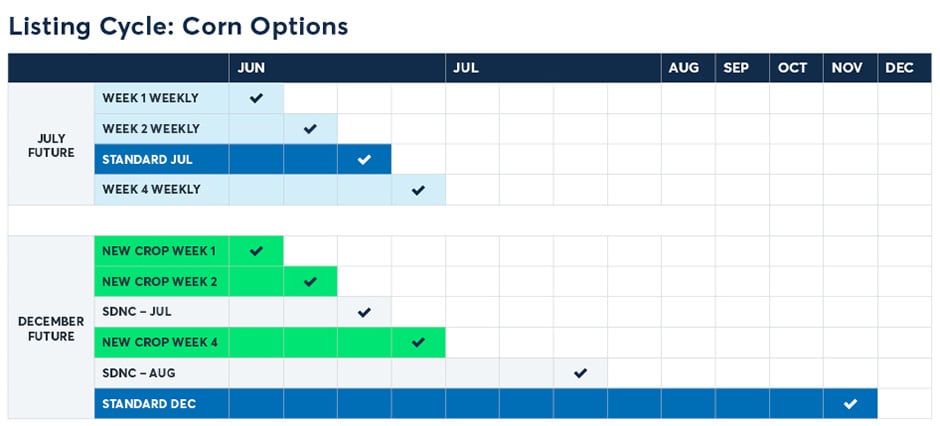
| New Crop Weekly options | New Crop | Friday Expirations | 5 cents |
| Short-Dated New Crop options | New Crop | Monthly Expirations | 10 cents strike increments 3 months out, 5 cents less than 3 months |
| Live Cattle Monday Weekly options | Front Month | Every Monday | $1.00 |
Understanding old crop vs. new crop
Old crop futures represent grain that has already been harvested, whereas new crop futures represent crops that are yet to be harvested. Both contracts are based on the same commodity but are fundamentally very different and can act accordingly. Old crop contracts typically have more volatility given macro sensitivities in comparison to new crop futures.
Short-term option scenarios
Price reactions will differ between old crop and new crop contracts. Market participants can easily define length of exposure and the underlying contract with our suite of short-term Agricultural options. Explore these example scenarios to learn how market participants can use different futures contracts to help manage risk.
| Scenario | Old Crop - WEEKLY | New Crop - NCW AND SDNC |
| Weather | ||
| USDA Reports | ||
| Geopolitical Issues | ||
| Export Change | ||
| Yield Expectations | ||
| Production Hedging / Production Marketing |
Weather-driven views
An active trader wants to enter the corn market given an upcoming heatwave that they expect to impact price. New crop contracts represent grain that has not yet been harvested, so the weather has a bigger impact on price volatility. The active trader chooses New Crop Weekly options for a cost-effective way to gain exposure to short-term market fluctuations.
Scale selling for production hedging
In March, a corn producer is looking to forward-sell 20% of their crop by June, anticipating an impending price drop due to supply surplus later in the year. Using a July Short-Dated New Crop put, the producer can purchase a higher strike for a lower cost compared to December options. The put purchase guarantees the producer the right to sell at the strike price while allowing for upside participation.
Managing price changes driven by reports
In April, a hog producer who uses soybean meal as an input has upside price risk to the nearby futures contract. Forecasts, policy change and USDA reports can have a large impact on prices. Grain and Oilseed Weekly options are based on the front-month futures and now expire every day of the trading week. The food supplier utilizes a Weekly call option to hedge the price risk of soybean meal rising from the USDA WASDE report.
Managing price changes driven by reports
In September, a cattle feeder who plans to sell his cattle in October has downside price risk tied to the October futures price. There is an upcoming USDA Cattle on Feed report that could move the market, potentially to the downside. Live Cattle Monday Weekly options expire every week, generally the business day after Cattle on Feed reports are published. To protect himself against this possible downward price move, the cattle feeder purchases a Live Cattle Monday Weekly put option that settles against the October futures contract.
Compare different short-term options
For the shortest time frame exposure on new crop, explore New Crop Weekly options.
Product codes
How they are designed:
- Underlying futures are based on December Corn and November Soybeans
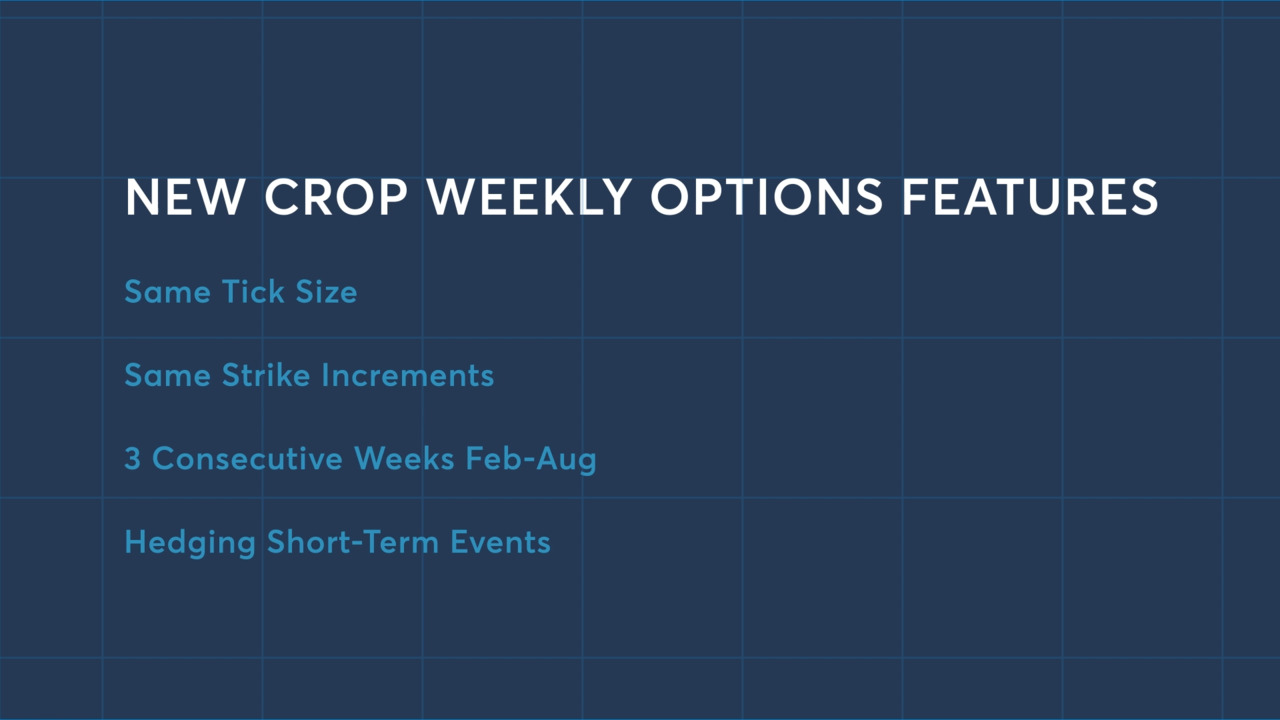
- Option expiration every Friday that is not a Short-Dated expiration from February through August
- Same tick size, strike interval, and expiration style as standard options
- Listed up to 4 weeks out at a time
How you can benefit:
- Very short time frame, resulting in reduced premium costs
- Hedge around high-impact events such as USDA WASDE reports pinpointing new crop exposure
- Volatility is historically lower for new crop leading to lower premium costs compared to old crop
If you’re looking for exposure one to three months out on new crop, explore Short-Dated New Crop options.
Product codes
| PRODUCT | CME GLOBEX | BLOOMBERG | CQG | PROPHETX |
| Corn | OCD | ODCA | ZCE1-5 | @OCD |
| SRW Wheat | OWD | ODWA | ZWA1-5 | @OWD |
| HRW Wheat | KWE | KWE1-5 | @KWE | |
| Soybean Meal | OMD | ZME1-5 | @OMD | |
| Soybean Oil | OLD | ZLE1-5 | @OLD | |
| Soybean Options | OSD | ODSA | @OSD |
How they are designed:
- Underlying futures are always based on the new crop
- Monthly expirations listed year round extending into two crop cycles
- Same expiration date as standard Grain and Oilseed options
How you can benefit:
- Hedge long-term exposure in short time frames (weeks to months) to take advantage of market fluctuations on new crop
- Useful in North American summer months when Corn and Soybeans have the most volatility and standard option premium is expensive
- Effective way to market a portion of grain throughout the growing season
For the shortest time frame exposure on old crop, explore Weekly options.
Product codes
| PRODUCT | Monday | Tuesday | Wednesday | Thursday | Friday | |||||
| CME GLOBEX |
BLOOMBERG | CME GLOBEX |
BLOOMBERG | CME GLOBEX |
BLOOMBERG | CME GLOBEX |
BLOOMBERG | CME GLOBEX |
BLOOMBERG | |
| Corn | 1-5CA | KJIA | 1-5BC | KJLA | 1-5CW | KJOA | 1-5HC | KJPA | ZC1-5 | 1XA - 5XA |
| Soybean | 1-5SA | QHAA | 1-5SB | QHBA | 1-5SC | QHIA | 1-5SD | QHLA | ZS1-5 | 1SA-5SA |
| SRW Wheat | 1-5WA | WZIA | 1-5WB | WZLA | 1-5WC | WZOA | 1-5WD | WZPA | ZW1-5 | 1ZA-5ZA |
| Soybean Meal | 1-5MA | WYAA | 1-5MB | WYBA | 1-5MC | WYCA | 1-5MD | WYDA | ZM1-5 | 1DA-5DA |
| Soybean Oil | 1-5OA | OZIA | 1-5OB | OZLA | 1-5OC | OZSA | 1-5OD | OZTA | ZO1-5 | 1AA-5AA |
How they are designed:
- Underlying is the front month futures contract
- Expire every trading day that is not a standard option expiration
- Listed up to 4 weeks out at a time
- Same tick size, strike interval and expiration style as standard options
How you can benefit:
- Expirations every day of the trading week, very short time frame (days) on liquid underlying and strong option liquidity
- Year-round, constant hedging for individuals to manage ongoing front month exposure for end users such as ethanol plants, feed lots or millers
- Low premium/exposure for retail traders to take a position in Grains and Oilseeds
Hedge cattle risk around feed reports with Live Cattle Monday Weekly options.
Product codes
| PRODUCT | CME GLOBEX | BLOOMBERG | CQG | PROPHETX |
| Live Cattle Monday Weekly options | L1-5C | LDCA | GLE11-GLE15 | @L1C - @L5C |
How they are designed:
- Underlying is the front month
- Expire every Monday
- Listed up to 3 weeks out
- Same tick and strike interval as standard Live Cattle options
How you can benefit:
- Low premium
- Hedge around high-impact events
- Leverage short-term market fluctuations

Courses
Take self-guided courses on Agricultural futures and options.
If you’re new to Agricultural futures and options, the following courses can help you learn more about the benefits of short-term options and when it’s beneficial to leverage old crop versus new crop contracts.
Product updates and analysis on short-term options
Get the latest updates on Agricultural short-term options.