| Consensus | Consensus Range | Actual | Previous | Revised | |
| Job Openings | 7.350M | 7.200M to 7.650M | 7.359M | 7.594M | 7.537M |
Highlights
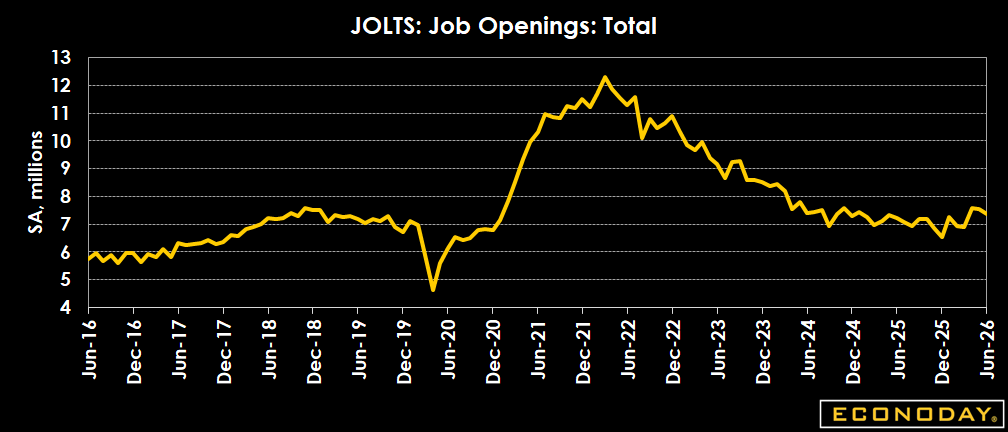
Job openings were down 178,000 in June to 7.359 million from 7.537 million in May, slightly more than the 7.350 million consensus in an Econoday survey of forecasters.
Private sector job openings fell 187,000 to 6.536 million. The largest increase was in transportation, warehousing, and utilities, up 97,000. Financial activities rose 58,000, driven by finance and insurance (+43,000) and real estate and rental and leasing (+16,000). Retail trade increased 49,000 and construction rose 14,000.
On the downside, the largest decline was in health care and social assistance, down 147,000, which drove a 133,000 drop in private education and health services overall (partially offset by a 13,000 increase in private educational services). Wholesale trade fell 74,000, professional and business services declined 71,000, and accommodation and food services dropped 68,000. Within manufacturing, down 36,000 overall, job openings fell 55,000 in nondurable goods, partly offset by an 18,000 gain in durable goods.
Government job openings rose 10,000 to 823,000 in June. Federal openings increased 39,000, while state and local openings declined 29,000.
Hiring rose 96,000 to 5.348 million in June, with private-sector hiring up 118,000 and government hiring down 21,000. Within the private sector, the largest gain was in health care and social assistance, up 69,000. Construction hiring rose 41,000 and manufacturing increased 33,000, all in durable goods.
The largest decline was in leisure and hospitality, down 87,000, driven by a 77,000 drop in accommodation and food services. Within government, federal hiring fell 6,000, and state and local hiring, excluding education, fell 20,000.
Total job separations rose 91,000 to 5.351 million, led by a 92,000 increase in the private sector. The largest increase was in retail trade, up 41,000. Separation in durable manufacturing rose 25,000, while they declined 16,000 in nondurable manufacturing. By contrast, the largest decline was in transportation, warehousing, and utilities, down 42,000. Government separations were little changed, down 2,000.
Total quits, a subset of separations, rose 79,000 in June to 3.232 million. Quits in private industries increased 77,000, while little changed in government, where they increased 2,000 (federal quits fell 4,000, state and local rose 6,000). The largest increase was in accommodation and food services, up 40,000. Retail trade rose 31,000, and wholesale trade increased 26,000. On the downside, quits in transportation, warehousing, and utilities declined 28,000, finance and insurance fell 19,000, and private educational services dropped 11,000.
Layoffs and discharges, another subset of separations, rose 5,000 to 1.766 million in June, all in the private sector, while government layoffs were unchanged. The largest increase was in professional and business services, up 41,000. Arts, entertainment, and recreation layoffs rose 21,000. Manufacturing layoffs decreased 4,000, due to weakness in nondurable. Layoffs and discharges fell 29,000 in accommodation and food services.
Market Consensus Before Announcement
A 7.35 million unit rate of job openings is the call for June, down from 7.59 million in May.