| Consensus | Consensus Range | Actual | Previous | Revised | |
| Job Openings | 7.298M | 6.975M to 7.600M | 7.594M | 7.618M | 7.585M |
Highlights
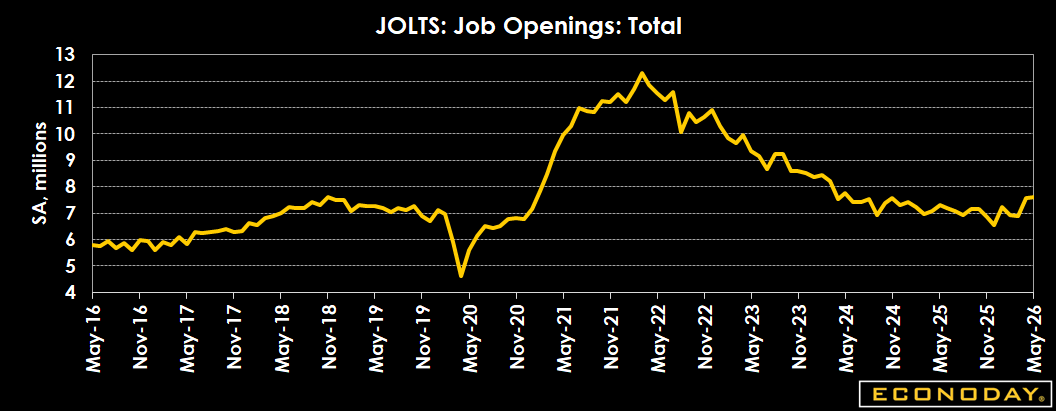
Job openings were little changed in May, up 9,000 to at 7.594 million from 7.585 million in April, beating the consensus of 7.298 million in an Econoday survey of forecasters.
Private sector job openings edged up 2,000 to 6.794 million. Leisure and hospitality led the increase, up 95,000, driven by accommodation and food services (+62,000) and arts, entertainment, and recreation (+33,000). Wholesale trade rose 71,000, while manufacturing and construction were up 33,000 and 32,000, respectively.
On the downside, the largest decline was in private education and health services, down 119,000, driven by a 115,000 drop in health care and social assistance. Finance and insurance fell 69,000, and other services declined 54,000. Transportation, warehousing, and utilities fell 43,000.
Government job openings increased 7,000 in May to 800,000. State and local openings rose 20,000, while federal openings declined 14,000.
Hiring was down 45,000 to 5.170 million in May, with private-sector hiring down 77,000 and government hiring up 32,000. Within the private sector, the largest declines were in trade, transportation, and utilities, down 56,000, including a 40,000 drop in transportation, warehousing, and utilities, and a 20,000 decline in wholesale trade. Construction hiring fell 24,000.
The largest gains were in government, up 32,000, with gains in both federal government (+11,000) and state and local (+21,000).
Total job separations were up 63,000 to 5.101 million, led by a 62,000 increase in the private sector. Private education and health services rose 34,000, driven by a 35,000 increase in health care and social assistance. Transportation, warehousing, and utilities increased 39,000, and other services rose 37,000. By contrast, professional and business services separations fell 20,000, while leisure and hospitality declined 17,000.
Total quits, a subset of separations, rose 22,000 in May to 3.065 million. Quits in private industries increased 37,000, while they fell 15,000 in government. The largest increases were in leisure and hospitality, up 43,000. Other services rose 31,000 and transportation, warehousing, and utilities increased 32,000. On the downside, quits in health care and social assistance declined 34,000, and construction was down 28,000.
Layoffs and discharges, another subset of separations, were up 41,000 to 1.708 million in May, with private sector layoffs up 27,000 and government up 14,000. Layoffs in trade, transportation, and utilities rose 52,000, driven by a 43,000 rise in retail trade. Leisure and hospitality layoffs were down 50,000, including a 42,000 drop in arts, entertainment, and recreation, and professional and business services were down 37,000.
Market Consensus Before Announcement
The consensus sees job openings down at 7.298 million unit rate in May from 7.618 million in April. That would suggest lower demand for workers consistent with a low-hire, low-fire economy.
Definition
The Labor Department's JOLTS report tracks monthly change in job openings and offers rates on hiring and quits. The reporting period lags other employment data including the employment situation report. The word JOLTS stands for Job Openings and Labor Turnover Survey.
Description
Although lagging the release timing of the employment situation report by a month, JOLTS provides additional information on the labor market. The payroll survey in the employment situation report provides numbers on net job changes. JOLTS breaks down labor market data into pre-net changes such as job openings, hires, and separations.