https://www.cmegroup.com/content/dam/cmegroup/images/common/default/article-940x600.jpg

US: Housing Market Index
| Consensus | Consensus Range | Actual | Previous | |
| Index | 34 | 34 to 35 | 37 | 34 |
Highlights
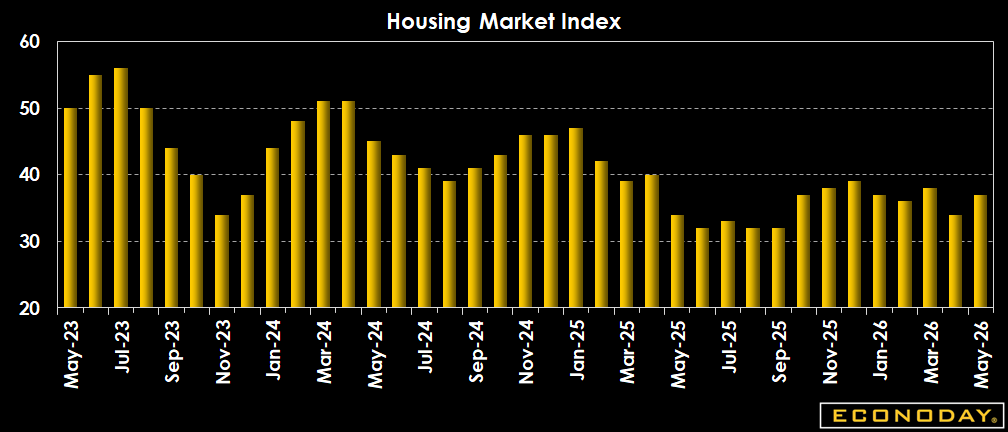
U.S. homebuilder sentiment rose more than expected this month, although market activity remains tepid as elevated borrowing costs and the cloudy economic outlook continues to dampen demand, while builders face"elevated land, labor and construction costs" due to rising energy prices.
Builder confidence in the market for newly built single-family homes was 37 in May, improving from 34 in April. Nevertheless, the report cautions that the market remains challenging.
The NAHB blamed the lackluster activity on higher mortgage rates, rising gasoline prices and economic uncertainty. Recent increases for long-term interest rates will continue to hold back home buyer demand, it warned.
Thirty-two percent of builders surveyed said they slashed prices in May. This compares with 36 percent in April and 37 percent in March. Thirty-seven percent cut prices in May 2025.
The average price reduction was 6 percent in May, compared to five percent in April as well as May 2025. The use of sales incentives was 61 percent, up from 60 percent in April. This is the 14th consecutive month this share has been 60 percent or higher.
Market Consensus Before Announcement
The housing market remains stuck in doldrums. The Econoday consensus looks for no change in the builder sentiment index at 34 in May from 34 in April.
Definition
The housing market index is a monthly composite that tracks home builder assessments of present and future sales as well as buyer traffic. The index is a weighted average of separate diffusion indexes: present sales of new homes, sales of new homes expected in the next six months, and traffic of prospective buyers of new homes.
Description
This report provides a gauge of not only the demand for housing, but the economic momentum. People have to be feeling pretty comfortable and confident in their own financial position to buy a house. Furthermore, this narrow piece of data has a powerful multiplier effect through the economy, and therefore across the markets and your investments. By tracking economic data such as the housing market index, investors can gain specific investment ideas as well as broad guidance for managing a portfolio. Whether the housing market index reflects new home sales or home resales, once a home is sold, it generates revenues for the realtor and the builder. It brings a myriad of consumption opportunities for the buyer. Refrigerators, washers, dryers and furniture are just a few items home buyers might purchase. The economic"ripple effect" can be substantial especially when you think a hundred thousand new households around the country are doing this every month. Since the economic backdrop is the most pervasive influence on financial markets, home sales have a direct bearing on stocks, bonds and commodities. In a more specific sense, trends in the existing home sales data carry valuable clues for the stocks of home builders, mortgage lenders and home furnishings companies.