https://www.cmegroup.com/content/dam/cmegroup/images/common/default/article-940x600.jpg

US: Housing Market Index
| Consensus | Consensus Range | Actual | Previous | |
| Index | 37 | 36 to 38 | 34 | 38 |
Highlights
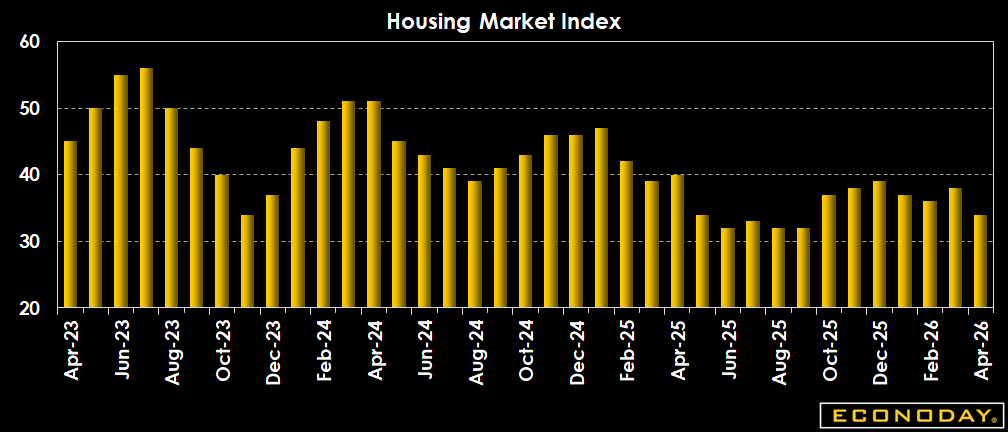
The NAHB/Wells Fargo housing market index (HMI) for April shows that it will take more than moderation in mortgage rates to lift builder confidence. The report indicates that homebuilders are already feeling the effects of higher prices related to increases in energy costs. Low consumer confidence, an uncertain economic outlook, and concerns about how to price new homes for sale are all cited as challenges facing builders.
The HMI is down 4 points to 34 in April, the lowest reading since 32 in September 2025 just when mortgage interest rates were beginning to moderate. The April reading is below the consensus of 37 in the Econoday survey of forecasters. The index has not broken above the 50-mark that signals expanding conditions since 51 in April 2024. New home sales were restrained by higher interest rates in 2024 and much of 2025, prices that kept some buyers out of the market, and by increased supplies of existing units for sale.
Although the decline in mortgage interest rates to within reach of 6 percent in January and February improved affordability for many buyers, home sales were hampered by extreme cold weather in those two months. At present, geopolitical uncertainty is affecting building supply chains and costs and discouraging builders from starting projects without a signed contract by the purchasers.
The index for present sales is down 4 points to 37 in April from 41 in March. The index for expected sales is down 7 points to 42 in April from 49 in March. The index for buyer traffic is down 3 points to 22 in April. The usual spring home buying season if off to slow start that is not anticipated to improve in the coming months.
Market Consensus Before Announcement
Homebuilder sentiment remains depressed with the index seen at 37 in April, down from 38 in March.
Definition
The housing market index is a monthly composite that tracks home builder assessments of present and future sales as well as buyer traffic. The index is a weighted average of separate diffusion indexes: present sales of new homes, sales of new homes expected in the next six months, and traffic of prospective buyers of new homes.
Description
This report provides a gauge of not only the demand for housing, but the economic momentum. People have to be feeling pretty comfortable and confident in their own financial position to buy a house. Furthermore, this narrow piece of data has a powerful multiplier effect through the economy, and therefore across the markets and your investments. By tracking economic data such as the housing market index, investors can gain specific investment ideas as well as broad guidance for managing a portfolio. Whether the housing market index reflects new home sales or home resales, once a home is sold, it generates revenues for the realtor and the builder. It brings a myriad of consumption opportunities for the buyer. Refrigerators, washers, dryers and furniture are just a few items home buyers might purchase. The economic"ripple effect" can be substantial especially when you think a hundred thousand new households around the country are doing this every month. Since the economic backdrop is the most pervasive influence on financial markets, home sales have a direct bearing on stocks, bonds and commodities. In a more specific sense, trends in the existing home sales data carry valuable clues for the stocks of home builders, mortgage lenders and home furnishings companies.