| Consensus | Consensus Range | Actual | Previous | |
| Index | 54.7 | 53.0 to 55.5 | 54.0 | 56.1 |
Highlights
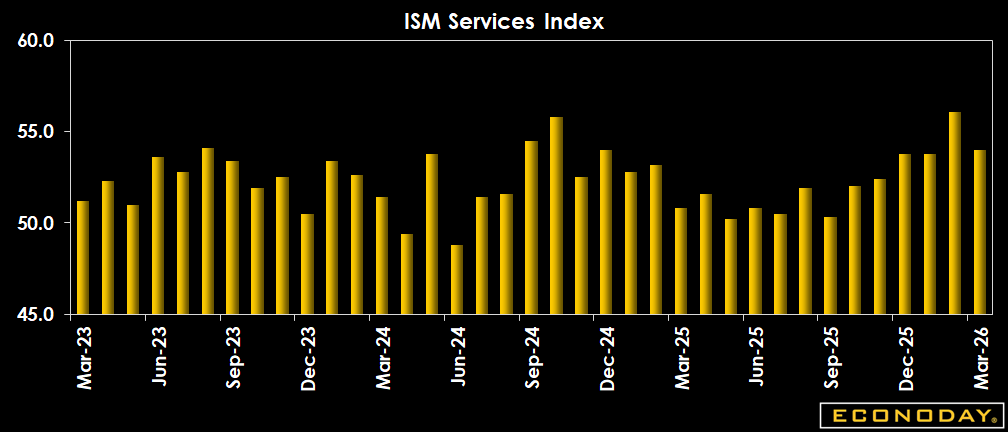
The U.S. services sector expands solidly again in March but the rate of expansion is slightly less than expected, data from the Institute for Supply Management show.
The ISM index, which shows the directional change of economic activity, is down 2.1 percentage points to 54.0 in March from 56.1 in February. That compares with expectations for 54.7 for March.
The services sector notably shows surging new orders at 60.6 in March versus 58.6 in February. Employment, on the other hand falls into contraction for the first time in four months at 45.2 in March versus 51.8 in February. Prices also rocket, as expected, to 70.7 from 63.0 in February, reflecting higher fuel prices due to the Iran war.
Market Consensus Before Announcement
The services PMI is seen a bit slower but still showing growth at 54.7 in March after surging to 56.1 in February from 53.8 in January. Services continue to expand nicely though price pressures threaten to spoil the party.
Definition
Producing a monthly composite on general activity tracked in volumes, the Institute for Supply Management surveys several hundred service-providing firms from 16 industries (construction and mining are included). The services composite index has four equally weighted components: business activity (closely related to a production index), new orders, employment, and supplier deliveries (also known as vendor performance). The first three components are seasonally adjusted but the supplier deliveries index does not have statistically significant seasonality and is not adjusted. For the composite index, a reading above 50 percent indicates that the services economy is generally expanding; below 50 percent indicates that it is generally declining. The supplier deliveries component index requires extra explanation: a reading above 50 percent indicates slower deliveries and below 50 percent indicates faster deliveries.
Description
Investors need to keep their fingers on the pulse of the economy because it dictates how various types of investments will perform. By tracking economic data like the ISM services index, investors will know what the economic backdrop is for the various markets. The services index is a composite of four equally weighted components: business activity, new orders, employment, and supplier deliveries. The stock market likes to see healthy economic growth because that translates to higher corporate profits. The bond market prefers less rapid growth and is extremely sensitive to whether the economy is growing too quickly -- and causing potential inflationary pressures. While the ISM manufacturing index has a long history that dates to the 1940s, this report goes back to 1997. Note that in 2020 the ISM changed the name of the report to services from non-manufacturing though it continues to track two key goods producing industries: construction and mining.