| Consensus | Consensus Range | Actual | Previous | Revised | |
| Initial Claims - Level | 211K | 198K to 215K | 206K | 209K | 212K |
| Initial Claims - Change | -6K | 9K | 12K | ||
| 4-Week Moving Average | 204K | 199K | 199.75K |
Highlights
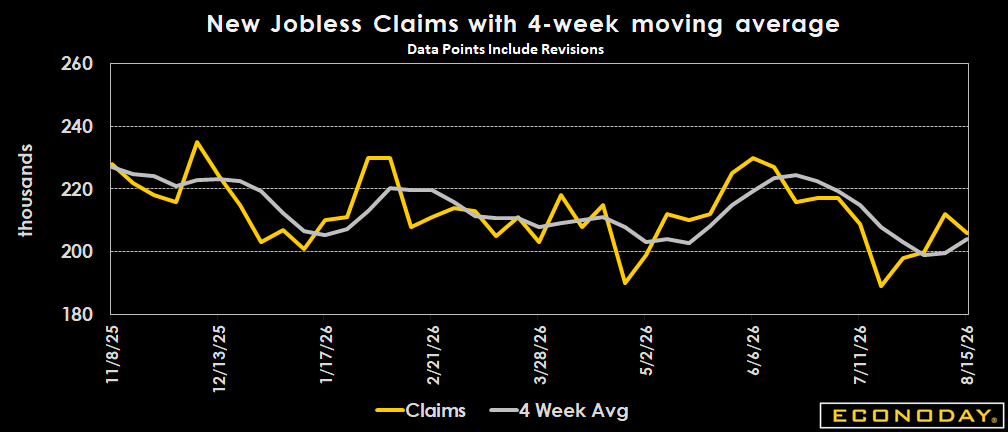
Initial jobless claims last week remained above the 200,000 mark for the third consecutive week and, more noteworthy, the four-week moving average bounced higher after being on a downward trajectory since the June 27 week. Longer-term claims remain just below 1.8 million.
This data will not move the needle in the monetary policy debate, with the focus on inflation data for August before the September 15-16 FOMC meeting.
Initial jobless claims came in lower than expected, with the level reported in the week ending August 15 down 6,000 from the revised 212,000 level reported for the prior week (previously 209,000). The August 15 week’s level compares to the consensus of 211,000 in the Econoday survey of forecasters. The four-week moving average is up by 4,250 to 204,000 in the August 15 week.
Seasonal factors had expected a decrease in unadjusted claims of 12,077 (-6.4 percent) from the previous week but instead fell 17,213 (-9.1 percent).
No states reported a notable rise in unadjusted initial claims. Only Michigan (-2,408) reported a significant decline in unadjusted first-time claims.
Insured unemployment was at 1.799 million in the August 8 week, with the prior week’s level revised to 1.781 million from 1.777 million. Continuing claims are lower by 158,000 vs. the same week a year ago. The four-week moving average is up 2,500 to 1.789 million, from 1.787 million in the August 1 week. The insured rate of unemployment remained at 1.2 percent in the August 8 week.
Market Consensus Before Announcement
Forecasters see claims up again to 211K this week from 209K last week, and 200K the week before that, and above the four-week moving average of 199K.
Definition
New unemployment claims are compiled weekly to show the number of individuals who filed for unemployment insurance for the first time. An increasing (decreasing) trend suggests a deteriorating (improving) labor market. The four-week moving average of new claims smooths out weekly volatility.
Description
Jobless claims are an easy way to gauge the strength of the job market. The fewer people filing for unemployment benefits, the more have jobs, and that tells investors a great deal about the economy. Nearly every job comes with an income that gives a household spending power. Spending greases the wheels of the economy and keeps it growing, so a stronger job market generates a healthier economy.
There's a downside to it, though. Unemployment claims, and therefore the number of job seekers, can fall to such a low level that businesses have a tough time finding new workers. They might have to pay overtime wages to current staff, use higher wages to lure people from other jobs, and in general spend more on labor costs because of a shortage of workers. This leads to wage inflation, which is bad news for the stock and bond markets. Federal Reserve officials are always on the look-out for inflationary pressures.
By tracking the number of jobless claims, investors can gain a sense of how tight, or how loose, the job market is. If wage inflation looks threatening, it's a good bet that interest rates will rise, bond and stock prices will fall, and the only investors in a good mood will be the ones who tracked jobless claims and adjusted their portfolios to anticipate these events.
Just remember, the lower the number of unemployment claims, the stronger the job market, and vice versa.