| Consensus | Consensus Range | Actual | Previous | Revised | |
| Initial Claims - Level | 208K | 205K to 210K | 211K | 200K | 199K |
| Initial Claims - Change | 12K | 10K | 9K | ||
| 4-Week Moving Average | 203.75K | 203.25K | 203K |
Highlights
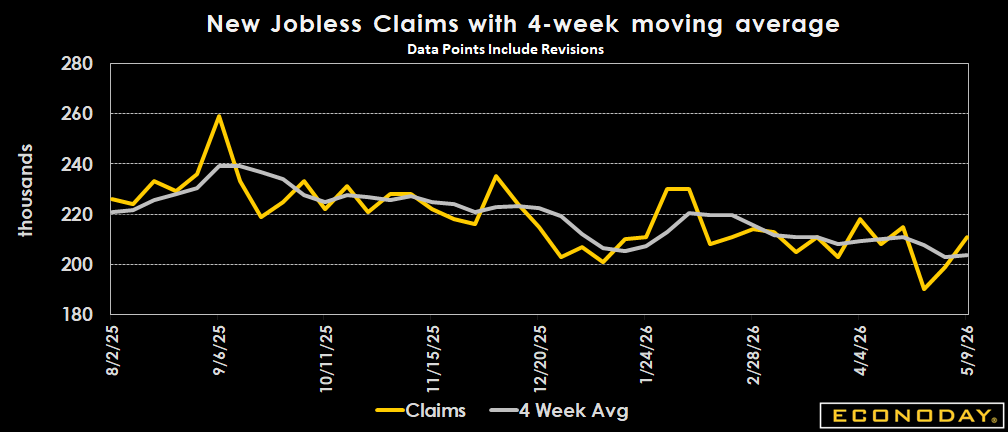
The volatile trend continues in initial jobless claims, with a pickup in last week's headline number after coming in below 200,000 in each of the prior two weeks. Employment conditions are entrenched at a slow hiring pace coupled with a few layoffs. The downward trajectory in longer-term claims below 1.8 million for the third straight week continues.
Initial jobless claims came in a bit more than expected, with the level reported in the week ending May 9 up 12,000 from the revised 199,000 level reported for the prior week (previously 200,000). The May 9 week's level compares to the consensus of 208,000 in the Econoday survey of forecasters. The four-week moving average is up by a mere 750 to 203,750 in the May 9 week.
Seasonal factors had expected a small rise in unadjusted claims of 199 (+0.1 percent) from the previous week, but instead there was a much larger increase of 10,258 (+5.7 percent).
Only Florida (+2,395) and Texas (+2,007) reported a noticeable rise in unadjusted first-time claims, while no states reported significant declines.
Insured unemployment was at 1.782 million in the May 2 week, with the prior week's level revised to 1.758 million from 1.766 million. Continuing claims are lower by 102,000 vs. the same week a year ago. The four-week moving average is down 6,750 to 1.781 million, from a downwardly revised 1.87 million in the April 25 week. The insured rate of unemployment remained at 1.2 percent in the May 2 week.
Market Consensus Before Announcement
The consensus keeps expecting claims to tick up, this week to 208K from 200K last week.
Definition
New unemployment claims are compiled weekly to show the number of individuals who filed for unemployment insurance for the first time. An increasing (decreasing) trend suggests a deteriorating (improving) labor market. The four-week moving average of new claims smooths out weekly volatility.
Description
Jobless claims are an easy way to gauge the strength of the job market. The fewer people filing for unemployment benefits, the more have jobs, and that tells investors a great deal about the economy. Nearly every job comes with an income that gives a household spending power. Spending greases the wheels of the economy and keeps it growing, so a stronger job market generates a healthier economy.
There's a downside to it, though. Unemployment claims, and therefore the number of job seekers, can fall to such a low level that businesses have a tough time finding new workers. They might have to pay overtime wages to current staff, use higher wages to lure people from other jobs, and in general spend more on labor costs because of a shortage of workers. This leads to wage inflation, which is bad news for the stock and bond markets. Federal Reserve officials are always on the look-out for inflationary pressures.
By tracking the number of jobless claims, investors can gain a sense of how tight, or how loose, the job market is. If wage inflation looks threatening, it's a good bet that interest rates will rise, bond and stock prices will fall, and the only investors in a good mood will be the ones who tracked jobless claims and adjusted their portfolios to anticipate these events.
Just remember, the lower the number of unemployment claims, the stronger the job market, and vice versa.