https://www.cmegroup.com/content/dam/cmegroup/images/common/default/article-940x600.jpg

US: EIA Petroleum Status Report
| Actual | Previous | |
| Crude Oil Inventories - W/W | 17.4M barrels | 2.5M barrels |
| Gasoline Inventories - W/W | -1.0M barrels | -1.6M barrels |
| Distillate Inventories - W/W | -0.1M barrels | -3.5M barrels |
Highlights
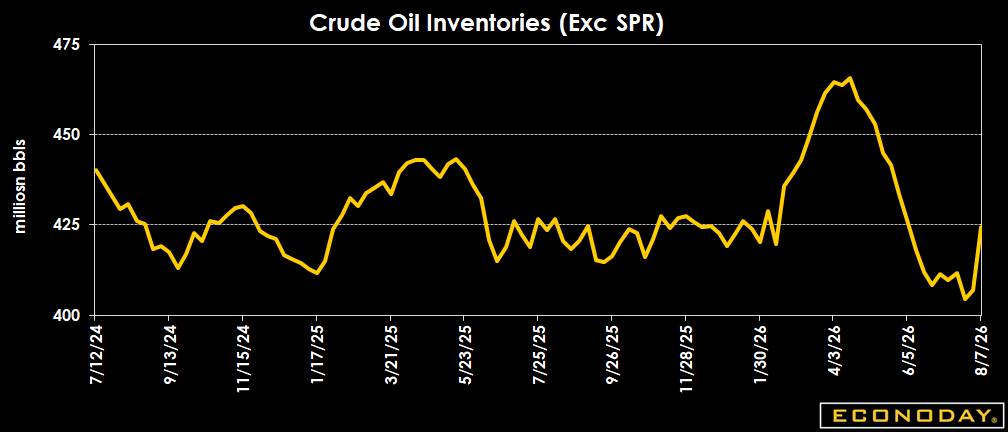
Crude oil inventories rocket higher by 17.4 million barrels to 424.4 million barrels in the week ended Aug. 7, 2026 from 407.0 million in the previous week. The magnitude of the increase is remarkable, as week to week changes are generally in single digits. It is also striking to see such a large rise given oil shortages related to the interruption in supplies from the Middle East. The latest total is 2 percent below the 5-year average for this time of year, and down 0.5 percent from a year ago.
Oil products, on the other hand, show continued declines, which is more consistent with the view that oil products are in short supply, and the US continues to draw down inventories to meet demand. Product inventories show motor gasoline down 1.0 million barrels from a week ago and 6 percent below the 5-year average for this time of year, and down 7.8 percent from a year ago. Distillates inventories decrease 0.1 million barrels, 12 percent below the average level for this time of year, and down 5.7 percent from a year ago.
Overall product demand over the last four weeks averages 20.7 million barrels a day, down 2.1 percent from the same period last year. Gasoline demand over the past four weeks averages 9.0 million barrels a day, down 0.5 percent from the same period last year. Distillate fuel demand averages 3.7 million barrels a day over the past four weeks, up 1.9 percent from a year ago. Jet fuel demand is up 3.8 percent compared with the four-week period last year.
Definition
The Energy Information Administration (EIA) provides weekly information on petroleum inventories in the U.S., whether produced here or abroad. The level of inventories helps determine prices for petroleum products.
Description
Petroleum product prices are determined by supply and demand - just like any other good and service. During periods of strong economic growth, one would expect demand to be robust. If inventories are low, this will lead to increases in crude oil prices - or price increases for a wide variety of petroleum products such as gasoline or heating oil. If inventories are high and rising in a period of strong demand, prices may not need to increase at all, or as much. During a period of sluggish economic activity, demand for crude oil may not be as strong. If inventories are rising, this may push down oil prices.
Crude oil is an important commodity in the global market. Prices fluctuate depending on supply and demand conditions in the world. Since oil is such an important part of the economy, it can also help determine the direction of inflation. In the U.S., consumer prices have moderated whenever oil prices have fallen, but have accelerated when oil prices have risen.