https://www.cmegroup.com/content/dam/cmegroup/images/common/default/article-940x600.jpg

US: Kansas City Fed Manufacturing Index
| Actual | Previous | |
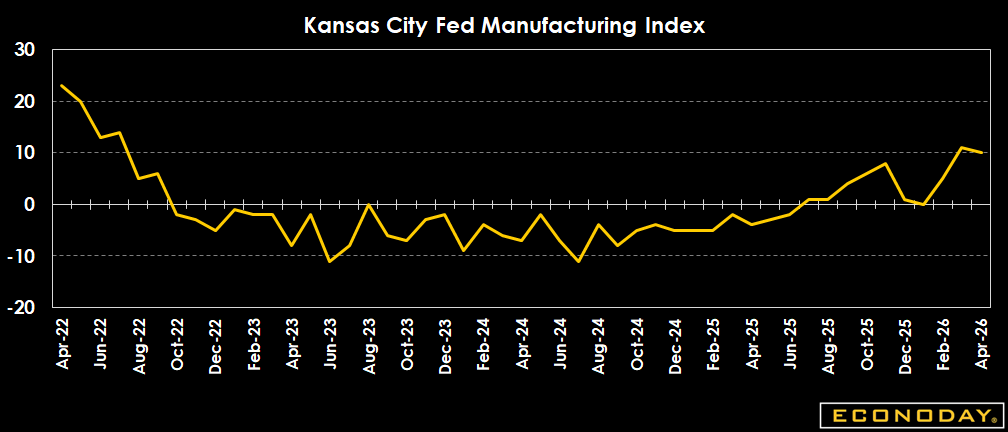
| Level | 10 | 11 |
Highlights
As with the S&P PMI flash manufacturing report released earlier Thursday, the Kansas City Fed manufacturing update shows resilience in April with an index at 10, nearly flat from 11 in March, which suggests ongoing modest growth.
New orders comes in at 12 in April versus 15 in March. Employment is at 2 in April versus 7 in March. The problem is input cost price pressures due to the US-Israel war with Iran: prices paid rockets to 63 in April from 37 in March. Prices received, meanwhile, are not keeping up at 25 in April versus 19 in March. That points to a squeeze on firms not passing on these higher costs.
In a special question, the survey finds 93 percent of firms seeing higher transport costs in April due to higher energy prices. Of these, two-thirds say they are passing on 0-20 percent of their higher transport costs. If energy costs stay this high, something has to give.
Definition
The Kansas City Fed index offers a monthly assessment of change in the region's manufacturing sector. Positive readings indicate monthly growth and negative readings monthly contraction. Readings at zero indicate no change. The headline number is the composite index, an average of the production, new orders, employment, delivery time, and raw materials inventory indexes.
Description
Investors track economic data like the Kansas City Survey of Manufacturers to understand the economic backdrop for the various markets. The stock market likes to see healthy economic growth because that translates to higher corporate profits. The bond market prefers a moderate growth environment that will not generate inflationary pressures. The survey gives a detailed look at Tenth District's manufacturing sector, how busy it is and where it is headed. Some of the survey indexes also provide insight on inflation pressures—including prices paid, prices received, wages & benefits, and capacity utilization. The equity market is also sensitive to this report because it is an early clue on the nation's manufacturing sector, reported in advance of the ISM manufacturing index and often in advance of the NAPM-Chicago index.