https://www.cmegroup.com/content/dam/cmegroup/images/common/default/article-940x600.jpg

US: Kansas City Fed Manufacturing Index
| Actual | Previous | |
| Level | 11 | 5 |
Highlights
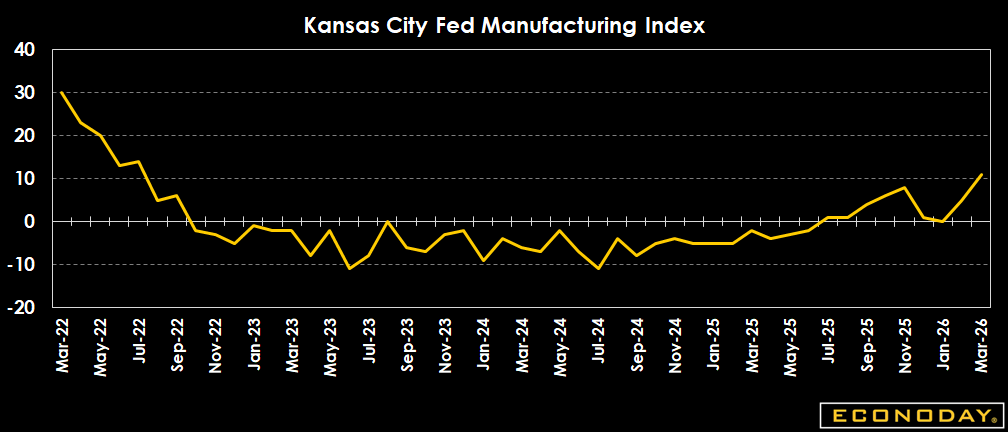
The Kansas City Fed composite index for manufacturing is up to 11 in March after 5 in February and the highest since 15 in July 2022. The increase reflects higher new orders and rising order backlogs that will help maintain production in the coming months. The six-month composite index is only slightly higher at 16 in March after 15 in February. This suggests that survey respondents in the district's factory sector are cautious about the outlook and will have to see more than a one-month upturn in activity before concluding that conditions are sustainably improved.
The biggest question about the near future is likely what is going to happen to input costs. The March index for prices paid is down to 37 after 42 in February. The surge in energy prices particularly motor fuels is not capture in this data. Costs are likely to move upward in the April numbers. The March index for prices received is 19 after 18 in February and points to pass through of higher costs to customers wherever possible.
The index for new orders is up to 15 in March from 7 in February and 0 in January. This rapid improvement suggests that there is some unmet demand being filled. The index for order backlogs is up to 13 in March from 8 in February and minus 11 in January. Having orders in the pipeline will help support manufacturing activity going forward. The index for shipments picks up to 20 in March after 11 in February and minus 2 in January.
The employment index is up to 7 in March from minus 6 in February and 0 in January. The workweek index is little changed at 7 in March from 6 in February and only slightly faster than 4 in January. Manufacturers are ramping up at a cautious pace.
The index for delivery times is up to 18 in March after 7 in February and 8 in January. This is probably a one-month increase related to unexpectedly firming orders and will cool in the coming months. The inventories index continues to hover within a narrow range around neutral at 3 in March 6 in February and minus 4 in January.
Definition
The Kansas City Fed index offers a monthly assessment of change in the region's manufacturing sector. Positive readings indicate monthly growth and negative readings monthly contraction. Readings at zero indicate no change. The headline number is the composite index, an average of the production, new orders, employment, delivery time, and raw materials inventory indexes.
Description
Investors track economic data like the Kansas City Survey of Manufacturers to understand the economic backdrop for the various markets. The stock market likes to see healthy economic growth because that translates to higher corporate profits. The bond market prefers a moderate growth environment that will not generate inflationary pressures. The survey gives a detailed look at Tenth District's manufacturing sector, how busy it is and where it is headed. Some of the survey indexes also provide insight on inflation pressures—including prices paid, prices received, wages & benefits, and capacity utilization. The equity market is also sensitive to this report because it is an early clue on the nation's manufacturing sector, reported in advance of the ISM manufacturing index and often in advance of the NAPM-Chicago index.