https://www.cmegroup.com/content/dam/cmegroup/images/common/default/article-940x600.jpg

US: PMI Manufacturing Final
| Actual | Previous | |
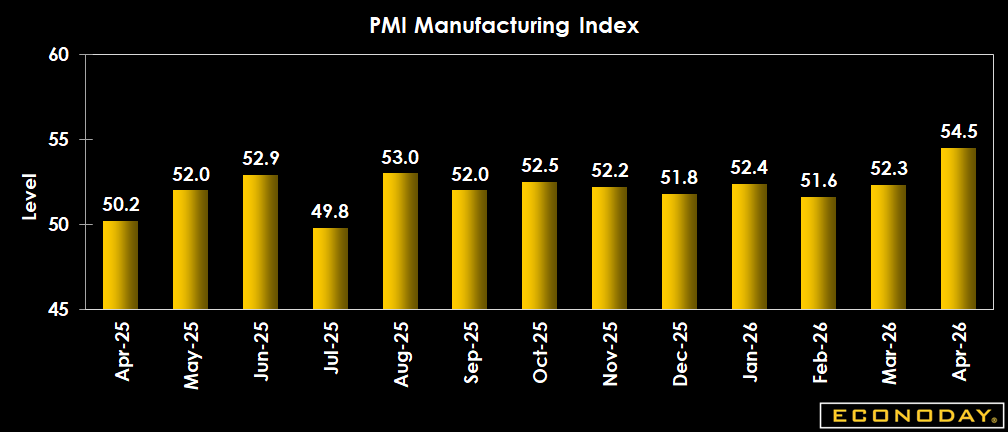
| Index | 54.5 | 52.3 |
Highlights
The S&P Global US Manufacturing Purchasing Managers' Index improved to 54.5 in April, compared to 52.3 in March. However, inventory building primarily drove the uptick in activity, as surging raw material prices and supply chain disruptions drove firms to get ahead of transportation delays and pricing pressures by building up inventories.
Indeed, both input and output prices rose at accelerated rates, with inflation in each instance the steepest for ten months, the report said. There was also evidence that higher cost burdens influenced hiring decisions as the non-replacement of voluntary leavers pushed employment levels lower for the first time in nine months.
The report also noted that the rise in new orders was mostly limited to domestic demand, with export levels falling for the eleventh straight month. Tariffs, as well as the conflict in the Middle East, dampened sales.
Looking ahead, manufacturers remain upbeat about the outlook for production, tied to confidence that the Iran war's impact would not be as bad as previously feared, while the impact of tariffs would likely wane over the coming months. As a result, the degree of confidence improved to the highest since February 2025, the report said.
Input cost inflation rose to a ten-month high and remained historically elevated. Goods producers responded by recording their most pronounced uplift in charges since June 2025.
On the jobs front, cost concerns negatively impacted employment, with firms choosing not to replace job leavers as material shortages and supply disruption pushed up input prices sharply during April.
Definition
Based on monthly questionnaire surveys of selected companies, the Purchasing Managers' Manufacturing Index (PMI) offers an advance indication on month-to-month activity in the private sector economy by tracking changes in variables such as production, new orders, stock levels, employment and prices across manufacturing industries. The final index for the current month is released roughly a week after the flash.
Description
Investors need to keep their fingers on the pulse of the economy because it dictates how various types of investments will perform. By tracking economic data such as the ISM manufacturing index in the U.S. and the Markit PMIs in the U.S. and elsewhere, investors will know what the economic backdrop is for the various markets. The stock market likes to see healthy economic growth because that translates to higher corporate profits. The bond market prefers less rapid growth and is extremely sensitive to whether the economy is growing too quickly and causing potential inflationary pressures.
The Markit PMI manufacturing data give a detailed look at the manufacturing sector, how busy it is and where things are headed. Since the manufacturing sector is a major source of cyclical variability in the economy, this report has a big influence on the markets. And its sub-indexes provide a picture of orders, output, employment and prices.
Markit originally began collecting monthly Purchasing Managers' Index (PMI) data in the U.S. in April 2004, initially from a panel of manufacturers in the U.S. electronics goods producing sector. In May 2007, Markit's U.S. PMI research was extended out to cover producers of metal goods. In October 2009, Markit's U.S. Manufacturing PMI survey panel was extended further to cover all areas of U.S. manufacturing activity. Back data for Markit's U.S. Manufacturing PMI between May 2007 and September 2009 are an aggregation of data collected from producers of electronic goods and metal goods producers, while data from October 2009 are based on data collected from a panel representing the entire U.S. manufacturing economy. Markit's total U.S. Manufacturing PMI survey panel comprises over 600 companies.