https://www.cmegroup.com/content/dam/cmegroup/images/common/default/article-940x600.jpg

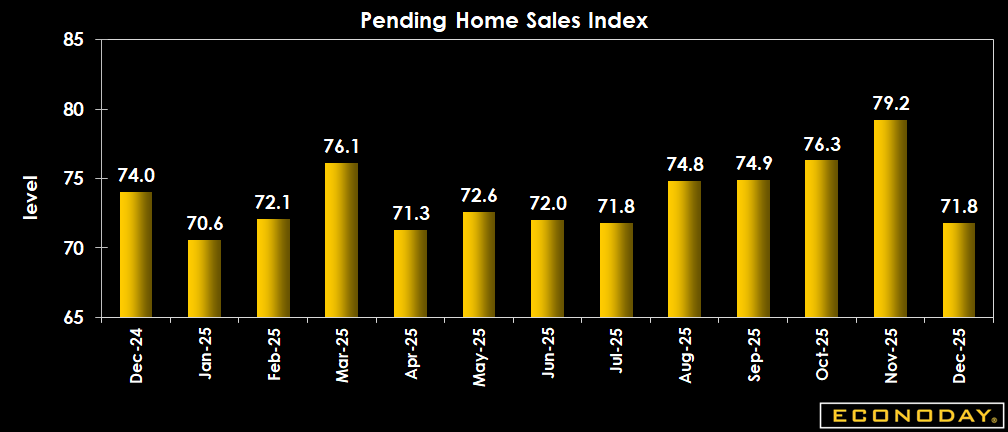
US: Pending Home Sales Index
| Actual | Previous | Revised | |
| Month over Month | -9.3% | 3.3% | 5.7% |
| Index | 71.8 | 79.2 |
Highlights
The NAR's pending home sales index for December sees an abrupt end to the rising pace of contract signings of the prior four months. Despite lower mortgage rates, potential homebuyers may be waiting for yet lower rates in the near future before committing to a purchase. Buyers may be facing decreased inventory of available homes for sale and consequent competition for the more sought-after units which will discourage some activity. Home sales are also facing low consumer confidence about the US economy and be unwilling to take on a mortgage in an uncertain labor market.
The November pending homes sales index is down 9.3 percent to 71.8 after an unrevised 79.2 in November and is down 3.0 percent compared to a year ago. The December index is well below the consensus of 79.2 in the Econoday survey of forecasters. The unexpected decline may be in part due to difficulties in seasonally adjusting data in December which exaggerated the fall in new contracts. However, it also suggests that consumers are not shopping for homes absent a compelling reason to buy now.
Pending home sales contracts use mortgage for which the buyer has qualified recently, mostly in November and December. The monthly average rate for Freddie Mac 30-year fixed rate mortgages was essentially unchanged at 6.24 percent in November but down to 6.19 percent in December. Homebuyers who qualified for a mortgage in November may have decided to wait until a lower rate is available and then return to home shopping. The Freddie Mac average is down to 6.12 percent for January to date and could help fuel a rush to buy in January before inventories are further drained.
Definition
The National Association of Realtors developed the pending home sales index as a leading indicator of housing activity. Specifically, it is a leading indicator of existing home sales, not new home sales. A pending sale is one in which a contract was signed, but not yet closed. It usually takes four to six weeks to close a contracted sale.
Description
This provides a gauge of not only the demand for housing, but the economic momentum. People have to be feeling pretty comfortable and confident in their own financial position to buy a house. Furthermore, this narrow piece of data has a powerful multiplier effect through the economy, and therefore across the markets and your investments. By tracking economic data such as the pending home sales index which measures home resales, investors can gain specific investment ideas as well as broad guidance for managing a portfolio.
Even though home resales don't always create new output, once the home is sold, it generates revenues for the realtor. It brings a myriad of consumption opportunities for the buyer. Refrigerators, washers, dryers and furniture are just a few items home buyers might purchase. The economic"ripple effect" can be substantial especially when you think a hundred thousand new households around the country are doing this every month.
Since the economic backdrop is the most pervasive influence on financial markets, home resales have a direct bearing on stocks, bonds and commodities. In a more specific sense, trends in the existing home sales data carry valuable clues for the stocks of home builders, mortgage lenders and home furnishings companies.
The National Association of Realtors moved up its publication schedule in 2011. Prior to 2011, the reference month was two months trailing the release date. In 2011, the reference month trails only by one month to the release month.