| Consensus | Consensus Range | Actual | Previous | |
| Annual Rate | 3.970M | 3.900M to 4.050M | 3.980M | 4.06M |
| Month over Month | -2.0% | -1.7% | ||
| Year over Year | -1.2% | 0.7% |
Highlights
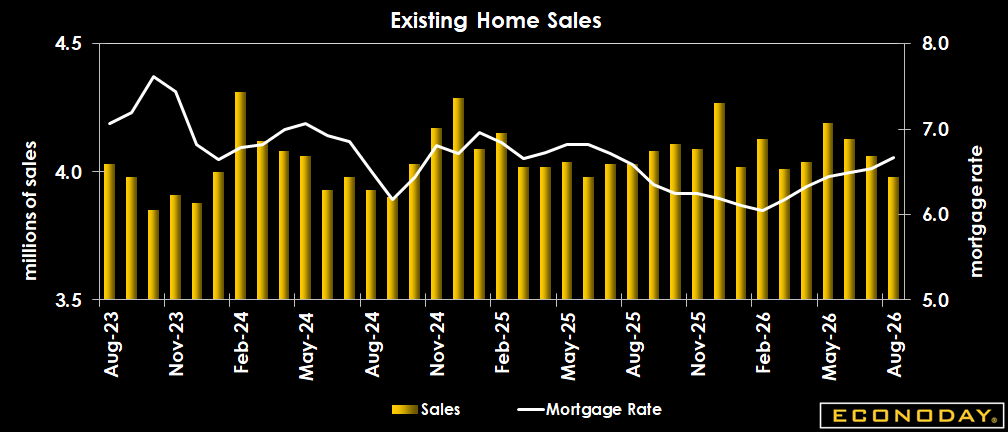
U.S. existing home sales slowed again in August, following no revision to July’s tepid reading, as high mortgage rates continue to weaken demand. The report notes, however, that home prices are rising and sales are up 1.6 percent for the January to August period.
The months’ supply of existing homes for sale finally rose after no change over the last four months and is up from the same month a year ago. This should offset the impact of high borrowing costs, somewhat, by giving buyers the upper hand in negotiations.
Month-over-month sales fell in the Northeast, Midwest, as well as the South, and were flat in the West. Year-over-year sales contracted in the Northeast, Midwest, and the West, while seeing no change in the South.
Sales of existing homes fell 2.0 percent to 3.98 million in August from 4.06 million in July (unrevised). Expectations in the Econoday survey of forecasters was for a 3.97 million annual rate. August’s rate is 1.2 percent lower compared to August 2025 (4.03 million).
Sales of single-family houses in August were at a 3.62 million annual rate, falling off the pace from the unrevised 3.xx million reported for July.
August’s single-family home sales rate is 1.9 percent weaker than July, and 1.1 percent behind the August 2025 rate of 3.66 million.
“Mortgage rates and home sales move in opposite directions, so it's not surprising to see a mild dip in home buying activity due to high mortgage rates,” the NAR said.
Nevertheless, “[t]he ample supply of homes for sale on the market is giving homebuyers better opportunities to negotiate.”
The median sales price of existing houses sold in August was $429,100 compared to $436,400 in July, and $422,400 in August 2025. The median sales price of single-family homes was $434,800 in August compared to $427,700 a year ago.
The inventory of new houses for sale rose from 1.57 million at the end of July to 1.62 million at the end of August. This translates to a months’ supply of 4.9 months in August, compared to 4.6 months in July at the current sales rate. Inventory was at 4.6 months of supply in August 2025.
Market Consensus Before Announcement
Rising mortgage rates to depress sales to a 3.97 million unit rate in August from 4.06 million in July.
Definition
Existing home sales tally the number of previously constructed homes, condominiums and co-ops in which a sale closed during the month. Existing homes (also known as home resales) account for a larger share of the market than new homes and indicate housing market trends.
Description
This provides a gauge of not only the demand for housing, but the economic momentum. People have to be feeling pretty comfortable and confident in their own financial position to buy a house. Furthermore, this narrow piece of data has a powerful multiplier effect through the economy, and therefore across the markets and your investments. By tracking economic data such as home resales, investors can gain specific investment ideas as well as broad guidance for managing a portfolio.
Even though home resales don't always create new output, once the home is sold, it generates revenues for the realtor. It brings a myriad of consumption opportunities for the buyer.
Refrigerators, washers, dryers and furniture are just a few items home buyers might purchase. The economic"ripple effect" can be substantial especially when you think a hundred thousand new households around the country are doing this every month. Since the economic backdrop is the most pervasive influence on financial markets, home resales have a direct bearing on stocks, bonds and commodities. In a more specific sense, trends in the existing home sales data carry valuable clues for the stocks of home builders, mortgage lenders and home furnishings companies.