| Consensus | Consensus Range | Actual | Previous | Revised | |
| Annual Rate | 4.08M | 4.01M to 4.10M | 4.17M | 4.02M | 4.04M |
| Month over Month | 3.2% | 0.2% | 0.7% | ||
| Year over Year | 3.2% | 0.0% | 0.5% |
Highlights
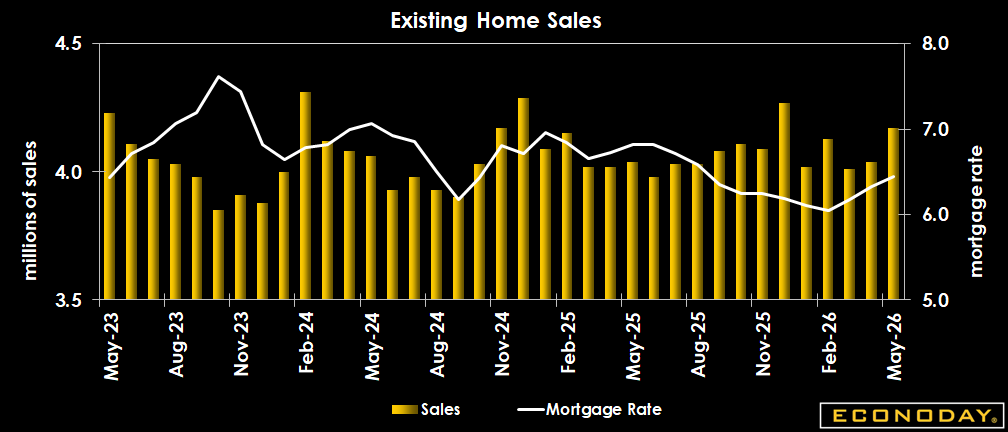
Sales beat expectations at an annual 4.17 million unit rate in May versus a revised 4.04 million rate in April (previously April was at a 4.02 million rate). The May increase is paced by sales of single-family homes, up 3.5 percent on the month to 3.80 million unit rate, while multifamily units are flat at 370,000 rate per month. A surprisingly resilient showing.
The median sales price is up 2.8 percent to $429,300 in May from $417,500 in April. That increase reflects solid fundamentals and constrained supply, NAR says. Homes are listed on average 29 days in May vs. 32 in April, and 27 in the year ago month.
Market Consensus Before Announcement
Seen only a little better at a 4.08 million unit rate in May versus 4.02 million in April as sales remain depressed with mortgage rates ticking up.
Definition
Existing home sales tally the number of previously constructed homes, condominiums and co-ops in which a sale closed during the month. Existing homes (also known as home resales) account for a larger share of the market than new homes and indicate housing market trends.
Description
This provides a gauge of not only the demand for housing, but the economic momentum. People have to be feeling pretty comfortable and confident in their own financial position to buy a house. Furthermore, this narrow piece of data has a powerful multiplier effect through the economy, and therefore across the markets and your investments. By tracking economic data such as home resales, investors can gain specific investment ideas as well as broad guidance for managing a portfolio.
Even though home resales don't always create new output, once the home is sold, it generates revenues for the realtor. It brings a myriad of consumption opportunities for the buyer.
Refrigerators, washers, dryers and furniture are just a few items home buyers might purchase. The economic"ripple effect" can be substantial especially when you think a hundred thousand new households around the country are doing this every month. Since the economic backdrop is the most pervasive influence on financial markets, home resales have a direct bearing on stocks, bonds and commodities. In a more specific sense, trends in the existing home sales data carry valuable clues for the stocks of home builders, mortgage lenders and home furnishings companies.