https://www.cmegroup.com/content/dam/cmegroup/images/common/default/article-940x600.jpg

US: Empire State Manufacturing Index
| Consensus | Consensus Range | Actual | Previous | |
| Index | 14.1 | -9.0 to 20.4 | 7.6 | 20.6 |
Highlights
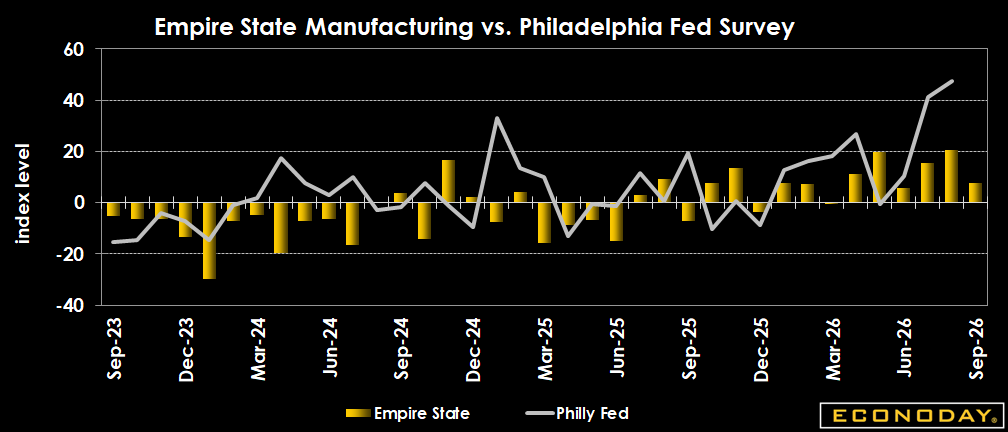
Business activity fades in September more than expected to an index of 7.6 -- versus 14.1 expected -- from 20.6 in August.
New orders leads the dip, down to 2.0 in September from 17.3 in August, not a favorable harbinger. Input price pressures are even more elevated at 63.1 in September from 58.6 in August.
Despite the dip in current business activity, sentiment about the outlook remains robust. The future conditions index is at 29.0 in September versus 32.1 in August.
Market Consensus Before Announcement
The business activity index is expected to recede to 14.1 in September, still showing expansion, from. 20.6 in August.
Definition
The New York Fed conducts this monthly survey of manufacturers in New York State. Participants from across the state represent a variety of industries. On the first of each month, the same pool of roughly 200 manufacturing executives (usually the CEO or the president) is sent a questionnaire to report the change in an assortment of indicators from the previous month. Respondents also give their views about the likely direction of these same indicators six months ahead.
Description
Investors track economic data like the Empire State Manufacturing Survey to understand the economic backdrop for the various markets. The stock market likes to see healthy economic growth because that translates to higher corporate profits. The bond market prefers a moderate growth environment that won't generate inflationary pressures. The Empire Manufacturing Survey gives a detailed look at New York state's manufacturing sector, how busy it is and where things are headed. Since manufacturing is a major sector of the economy, this report has a big influence on the markets. Some of the Empire State Survey sub-indexes also provide insight on commodity prices and other clues on inflation. The Federal Reserve closely watches this report because when inflation signals are flashing, policymakers can reset the direction of interest rates. As a consequence, the bond market can be highly sensitive to this report. The equity market is also sensitive to this report because it is the first clue on the nation's manufacturing sector, reported in advance of the Philadelphia Fed's business outlook survey.