https://www.cmegroup.com/content/dam/cmegroup/images/common/default/article-940x600.jpg

US: Empire State Manufacturing Index
| Consensus | Consensus Range | Actual | Previous | |
| Index | -2.0 | -3.1 to 3.3 | 11.0 | -0.2 |
Highlights
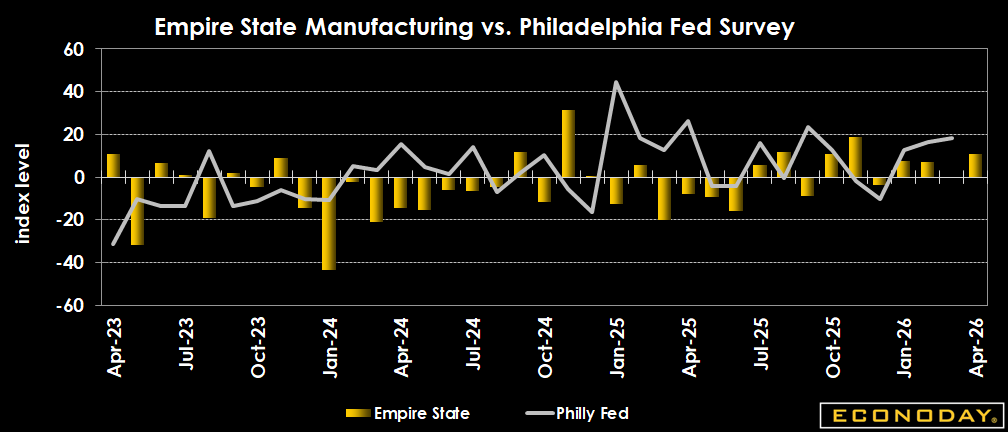
The general business conditions index in the New York Fed's Empire State manufacturing survey for April rebounds to 11.0 in April after minus 0.2 in March. The April index is well above the consensus of minus 2.0 in the Econoday survey of forecasters. The improved perception of current conditions should be read with caution. This index tends to be volatile and can exhibit big month-to-month swings. Survey respondents are probably reacting to ongoing expansion in new orders that is accompanied by growing backlogs to support activity in the coming months. However, the index for future business conditions falls to 19.6 in April from 31.0 in March. It retraces the more optimistic readings of the prior four months and suggests that economic uncertainty is weighing on manufacturers' outlook.
One of the big concerns is in higher costs for the factory sector from commodities prices. The current prices paid index jumps to 51.0 in April from 36.6 in March and is the highest since 52.6 in October 2025. Progress in disinflation for the factory sector has been halted. The index for prices received is little changed at 21.8 in April from 21.4 in March and indicates that pass through of higher costs is going to be challenging, but not absent. The future prices paid index jumps to 61.6 in April after 43.1 in March. The future index for prices received is up to 38.6 in April from 32.4 in March. The region's manufacturers are not expecting prices to come down soon.
The index for new orders is up to 19.3 in April from 6.4 in March while the index for order backlogs moderates slightly to 9.1 after 10.8. The orders index is the highest since 19.6 in April 2023. The pace for order backlogs remain about on trend for the past three months. The shipments index speeds up to 20.2 in April after minus 6.9 in March and minus 1.0 in February. Factories are catching up on incoming orders and moving them out, especially after weather delays during the winter months.
The index for delivery times is 12.1 in April after 13.7 in March. Supply chain movement has slowed down but not enough to yet constitute a problem, but bottlenecks could be forming. The index for inventories continues to show modest expansion at 5.1 in April after 6.9 in March.
The index for employment shows hiring is increasing at 9.8 in April after 5.8 in March and 4.0 in February. Factories may be hiring where they can find skilled workers. The index for the average workweek is up to 13.7 in April after 1.9 in March. Factories are adding hours as well as bringing on new workers.
Market Consensus Before Announcement
Manufacturing seen sluggish with the index barely in contraction territory at minus 2.0 for April, down from an already unimpressive minus 0.2 in March.
Definition
The New York Fed conducts this monthly survey of manufacturers in New York State. Participants from across the state represent a variety of industries. On the first of each month, the same pool of roughly 200 manufacturing executives (usually the CEO or the president) is sent a questionnaire to report the change in an assortment of indicators from the previous month. Respondents also give their views about the likely direction of these same indicators six months ahead.
Description
Investors track economic data like the Empire State Manufacturing Survey to understand the economic backdrop for the various markets. The stock market likes to see healthy economic growth because that translates to higher corporate profits. The bond market prefers a moderate growth environment that won't generate inflationary pressures. The Empire Manufacturing Survey gives a detailed look at New York state's manufacturing sector, how busy it is and where things are headed. Since manufacturing is a major sector of the economy, this report has a big influence on the markets. Some of the Empire State Survey sub-indexes also provide insight on commodity prices and other clues on inflation. The Federal Reserve closely watches this report because when inflation signals are flashing, policymakers can reset the direction of interest rates. As a consequence, the bond market can be highly sensitive to this report. The equity market is also sensitive to this report because it is the first clue on the nation's manufacturing sector, reported in advance of the Philadelphia Fed's business outlook survey.