| Consensus | Consensus Range | Actual | Previous | |
| Index | 51.2 | 48.7 to 51.8 | 62.7 | 49.2 |
Highlights
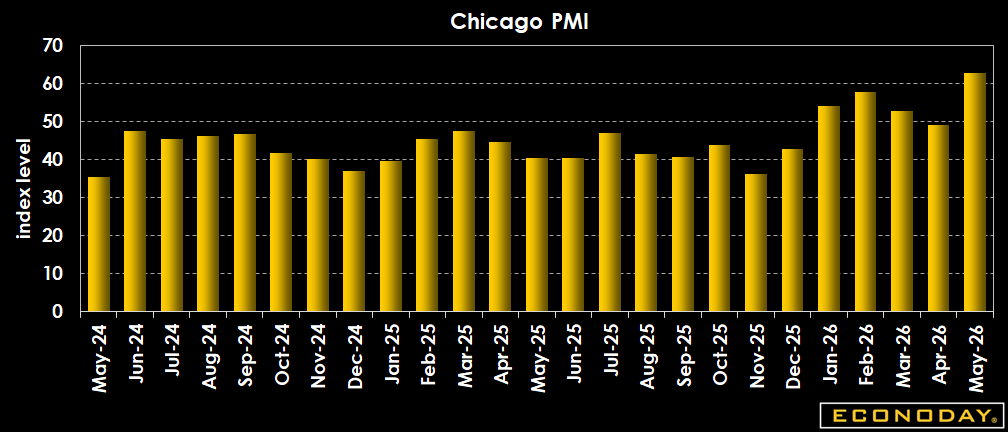
The notoriously volatile Chicago PMI rockets to 62.7 in May from 49.2 in April, well above the expected 51.2 in the Econoday consensus forecast and topping 51.2, the highest forecast in the Econoday range of forecasts. The move up is out of keeping with other regional surveys which have suggested only modest expansion in May.
If the number is to be believed, it suggests the Chicago region vaulted into strong growth in May after slight contraction in business activity in April. Recent seesaw moves in this index, starting with the surprising jump from contraction in December to expansion in January, raises questions about sample size and other aspects of the methodology. Take this with a large grain of salt in anticipating the US ISM manufacturing and services reports due next week.
Market Consensus Before Announcement
The index expected back up in expansion territory at 51.2 in May from 49.2 in April.
Definition
The Institute For Supply Management - Chicago compiles a survey and a composite diffusion index of business conditions in the Chicago area. Since October 2011, the survey has been conducted by Market News International. Manufacturing and non-manufacturing firms both are surveyed. Hence, it is not directly comparable to pure manufacturing surveys. Readings above 50 indicate an expanding business sector.
Description
Although the report is commonly referred to as the Chicago PMI, the official name of this report is ISM - Chicago. ISM stands for Institute For Supply Management while PMI is shorthand for purchasing managers' index.
Investors should track economic data like the Chicago PMI to understand the economic backdrop for the various markets. The stock market likes to see healthy economic growth because that translates to higher corporate profits. The bond market prefers a moderate growth environment that will not generate inflationary pressures. The Chicago PMI gives a detailed look at the Chicago region's manufacturing and non-manufacturing sectors. Many market players, focused on manufacturing, don't realize that non-manufacturing activity is covered in this index. On its own, it can be viewed as a regional indicator of general business activity. Some of the Chicago PMI's sub-indexes also provide insight on commodity prices and other clues on inflation. One should be aware that this report is released to private subscribers several minutes prior to release to the media. This may account for occasional market activity just prior to public release.
This survey is somewhat local in nature, reflecting overall economic activity in the Chicago area. But many see the Chicago PMI as being representative of the overall economy.
Markets focus on the overall index - the Business Barometer which many refer to as the Chicago PMI. The breakeven point for the index is 50. Readings above 50 indicate positive growth while numbers below 50 indicate contraction. The farther the reading is from 50, the more rapid the pace of growth or decline.