https://www.cmegroup.com/content/dam/cmegroup/images/common/default/article-940x600.jpg

US: Challenger Job-Cut Report
| Actual | Previous | |
| Level | 108,135 | 35,553 |
Highlights
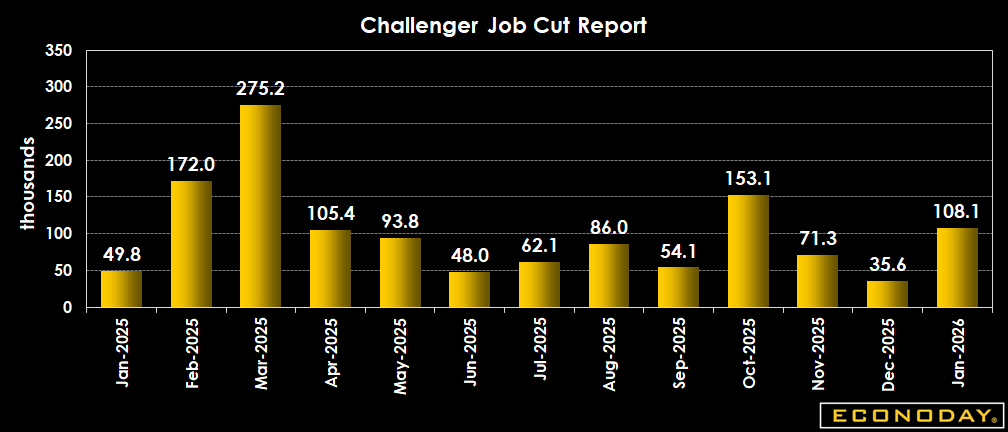
The Challenger job cut intentions report for January points to an uptick in job cuts reductions in hiring plans, elimination of open positions, and/or outright layoffs while the numbers of hiring intentions are limited and mostly in a few narrow industries. As 2025 starts, the labor market continues to look soft and on a tipping point into weakness.
Job cuts total 108,135 in January, up 204.2 percent from 35,553 in December and 117.2 percent from 47,795 in January 2025. The report notes that this is the highest January level since 241,749 in January 2009 which was just before unemployment began to rise sharply and then stayed elevated in what was called a jobless recovery.
In January, all but one industry announced at least some job cuts. The largest three account for 65.3% of the total. The largest are in transportation (31,243, or 28.9 percent), technology (22,291, or 20.6 percent), and health care and products (17,107, or 15.8 percent).
The reasons given for job cuts suggest that business activity is shrinking. The three largest reasons cited account for 73.1 percent of the total job cuts in January. These are contract loss (30,784, or 28.4 percent), market/economic conditions (28,392, or 26.2 percent), and restructuring (20,044, or 18.5 percent). There continue to be downstream impacts from the DOGE cuts in 2025 (826). Artificial intelligence (7,624) is specifically and noticeably adding to job cut intentions.
Hiring intentions are few and far between in January. Total intentions are 5,306 in January, down 33.7 percent from 10,496 in December and down 1.3 percent from 6,089 in January 2025. In January, the largest industry plans to hire are in insurance (2,500, or 47.1 percent of the total), followed by industrial goods (779, or 14.7 percent).
Definition
This monthly report counts and categorizes announcements of corporate layoffs based on mass layoff data from state departments of labor. The job-cut report must be analyzed with caution. It doesn't distinguish between layoffs scheduled for the short-term or the long term, or whether job cuts are handled through attrition or actual layoffs. Also, the job-cut report does not include jobs eliminated in small batches over a longer time period. Unlike most economic data, this series is not adjusted for seasonal variation.
Description
The job-cut report is basically a rehash of the weekly jobless claims report but provides additional insight into where layoffs are occurring. There is industry and geographic (states) detail that is not available with weekly jobless claims.