https://www.cmegroup.com/content/dam/cmegroup/images/common/default/article-940x600.jpg

US: ADP Employment Report
| Consensus | Consensus Range | Actual | Previous | Revised | |
| Private Payrolls - M/M | 120,000 | 65,000 to 130,000 | 122,000 | 109,000 | 105,000 |
Highlights
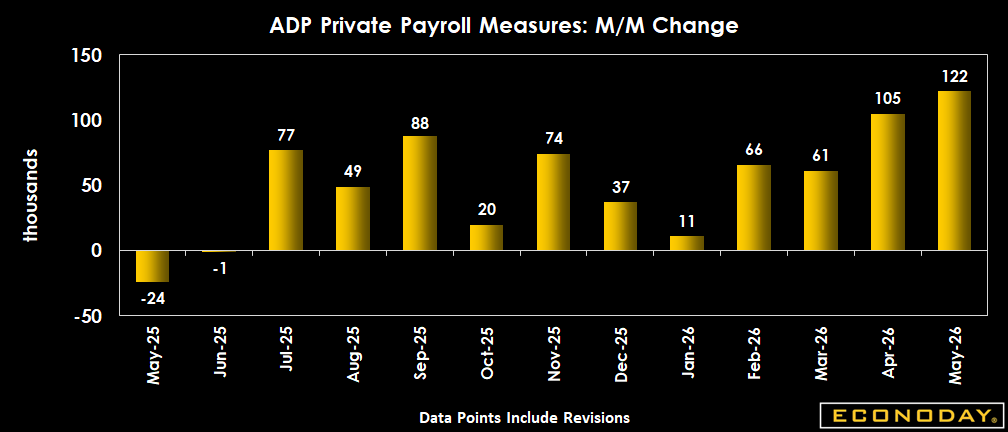
Job gains match expectations with a resilient gain of 122,000 in May after a revised 105,000 rise in April (versus 109,000 previously reported). The Econoday consensus looked for an increase of 120,000 for May.
These are steady, robust increases, and should reassure anyone who thought the economy would tank in the face of the energy price shock under way since the US and Israel attacked Iran on Feb. 28, or in the face of tariffs and other government policies adding to economic uncertainty, or AI. Robust because the labor force is diminished by lower immigration, so gains exceeding 100,000 are pretty darn strong.
Market Consensus Before Announcement
Jobs expected up by a decent 120K in May after rising by 109K in April.
Definition
The national employment report from Automated Data Processing Inc. is computed from ADP payroll data and offers advance indications on the U.S. workforce. ADP's data cover more than 500,000 companies totaling more than 25 million employees. The report is produced by ADP Research Institute in collaboration with Stanford Digital Economy Lab.
Description
Market players have become accustomed to the excitement on employment Friday and realize the rich detail of the monthly employment situation can help set the tone for the entire month. While economists have improved their nonfarm payroll forecasts over the years, it is not unusual to see surprises on employment Friday. To that end, the ADP's national employment report can help improve the payroll forecast by providing information in advance of the employment report.
The employment statistics also provide insight on wage trends, and wage inflation is high on the list of enemies for the Federal Reserve. Fed officials constantly monitor this data watching for even the smallest signs of potential inflationary pressures, even when economic conditions are soggy. If inflation is under control, it is easier for the Fed to maintain a more accommodative monetary policy. If inflation is a problem, the Fed is limited in providing economic stimulus.
By tracking jobs, investors can sense the degree of tightness in the job market. If wage inflation threatens, it's a good bet that interest rates will rise; bond and stock prices will fall. No doubt that the only investors in a good mood will be the ones who watched the employment report and adjusted their portfolios to anticipate these events. In contrast, when job growth is slow or negative, then interest rates are likely to decline - boosting up bond and stock prices in the process.