| Consensus | Consensus Range | Actual | Previous | Revised | |
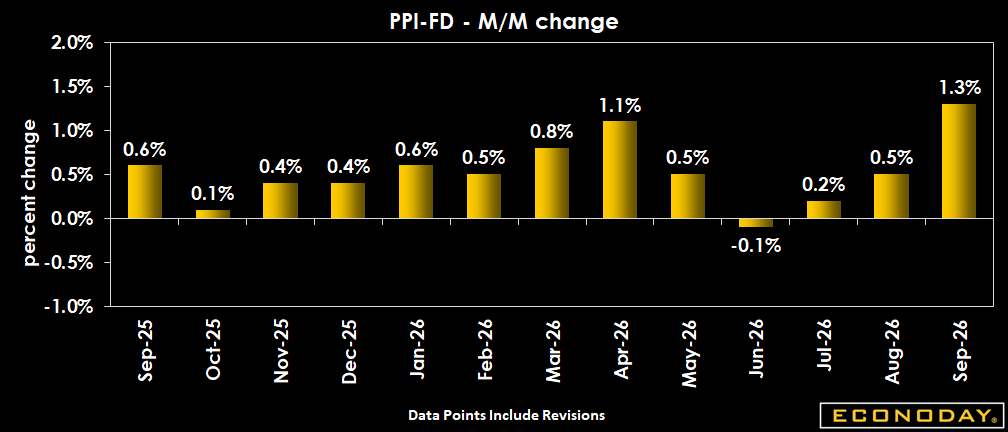
| PPI-FD - M/M | 0.5% | 0.4% to 0.8% | 1.3% | 0.4% | 0.5% |
| PPI-FD - Y/Y | 5.4% | 5.3% to 5.9% | 6.3% | 5.4% | 5.6% |
| Ex-Food & Energy - M/M | 0.3% | 0.2% to 0.4% | 0.7% | 0.2% | |
| Ex-Food & Energy - Y/Y | 4.5% | 4.4% to 4.7% | 5.0% | 4.6% | |
| Ex-Food, Energy & Trade Services - M/M | 0.5% | 0.3% | |||
| Ex-Food, Energy & Trade Services - Y/Y | 5.0% | 4.7% | 4.8% | ||
| PPI-FD Goods - M/M change | 2.6% | 1.1% | |||
| PPI-FD Goods - Y/Y change | 9.8% | 7.7% | |||
| PPI-FD Services - M/M change | 0.8% | 0.1% | 0.2% | ||
| PPI-FD Services - Y/Y change | 4.9% | 4.5% | 4.7% |
Highlights
Inflationary pressures were stronger than expected in September, even when excluding food and energy, adding pressure on the Federal Reserve to deliver another rate hike sooner rather than later. The final demand producer price index (PPI) increased 1.3 percent on the month following an upwardly revised 0.5 percent increase in August, the largest increase since March 2022. The 12-month rate picked up to 6.3 percent from 5.6 percent, the highest gain since December 2022. Forecasters in an Econoday survey had expected increases of 0.5 percent and 5.4 percent, respectively.
Excluding food and energy, wholesale prices were up 0.7 percent from August and 5.0 percent from a year earlier, topping even the highest forecasts of 0.4 percent and 4.7 percent, respectively.
Core prices excluding foods, energy, and trade services rose 0.5 percent in September, an acceleration from 0.3 percent in August, lifting the 12-month rate to 5.0 percent from 4.8 percent.
Today's data come on the back of a CPI report also showing intensifying inflationary pressures, with the year-over-year index up 3.7 percent in September after 3.4 percent in August. Excluding food and energy, consumer prices were up 2.6 percent in September, up from 2.4 percent the previous month.
At the wholesale level, the goods index rose a record 2.6 percent in September, more than twice as fast as the 1.1 percent advance in August. A 10.8 percent increase in energy, up from 4.5 percent in August, accounted for over 80 of the overall advance. The year-over-year good index reached 9.8 percent, up from 7.7 percent the previous month.
Services were up 0.8 percent in September after 0.2 percent in August, with the 12-month rate rising to 4.9 percent from 4.7 percent.
Market Consensus Before Announcement
PPI expected up 0.5 percent and 5.4 percent on year for September, lifted by energy costs.
Definition
The Producer Price Index (PPI) of the Bureau of Labor Statistics (BLS) is a family of indexes that measures the average change over time in the prices received by domestic producers of goods and services. PPIs measure price change from the perspective of the seller. Effective with the January 2014 PPI data release in February 2014, BLS transitioned from the Stage of Processing (SOP) to the Final Demand-Intermediate Demand (FD-ID) aggregation system. The headline PPI (for Final Demand) measures price changes for goods, services, and construction sold to final demand: personal consumption, capital investment, government purchases, and exports.
Description
The PPI measures prices at the producer level before they are passed along to final consumers. A portion of the inflation at the producer level gets passed through to the consumer price index (CPI). By tracking price pressures in the pipeline, investors can anticipate inflationary consequences in coming months.
While the CPI is the price index with the most impact in setting interest rates, the PPI provides significant information earlier in the production process. As a starting point, interest rates have an"inflation premium" and components for risk factors. A lender will want the money paid back from a loan to at least have the same purchasing power as when loaned. The interest rate at a minimum equals the inflation rate to maintain purchasing power and this generally is based on the CPI. Changes in inflation lead to changes in interest rates and, in turn, in equity prices.
The PPI comes in two key main versions: final demand (FD) and intermediate demand (ID). The final demand portion is composed of six main price indexes: final demand goods; final demand trade services; final demand transportation and warehousing services; final demand services less trade, transportation, and warehousing; final demand construction; and overall final demand.
The intermediate demand portion of the FD-ID system tracks price changes for goods, services, and construction products sold to businesses as inputs to production, excluding capital investment. There are two parallel treatments of intermediate demand, each constructed from the identical set of commodity price indexes. The first treatment organizes commodities according to commodity type, and the second organizes commodities using a stage-based, production flow model.
The PPI is considered a precursor of both consumer price inflation and profits. If the prices paid to producers increase, businesses are faced with either charging higher prices or taking a cut in profits. The ability to pass along price increases depends on the strength and competitiveness of the marketplace.
Under the prior PPI system, the producer price index was substantially more volatile than the consumer price index because the CPI included services while the PPI did not. Volatility has been reduced substantially in the PPI-FD due to the inclusion of services but the PPI still is more volatile than the CPI. Wages are a bigger share of the costs at the retail level than at the producer level and this plays a role in the CPI’s lower volatility. Also, the PPI does not include owners’ equivalent rent—a large and slow moving component in the CPI. Food and energy prices are major sources of volatility in the PPI, hence, the greater focus on the"core PPI" which excludes these two components.
The bond market rallies when the PPI decreases or posts only small increases, but bond prices fall when the PPI posts larger-than-expected gains. The equity market rallies with the bond market because low inflation promises low interest rates and is good for profits.