https://www.cmegroup.com/content/dam/cmegroup/images/common/default/article-940x600.jpg

US: International Trade in Goods and Services
| Consensus | Consensus Range | Actual | Previous | Revised | |
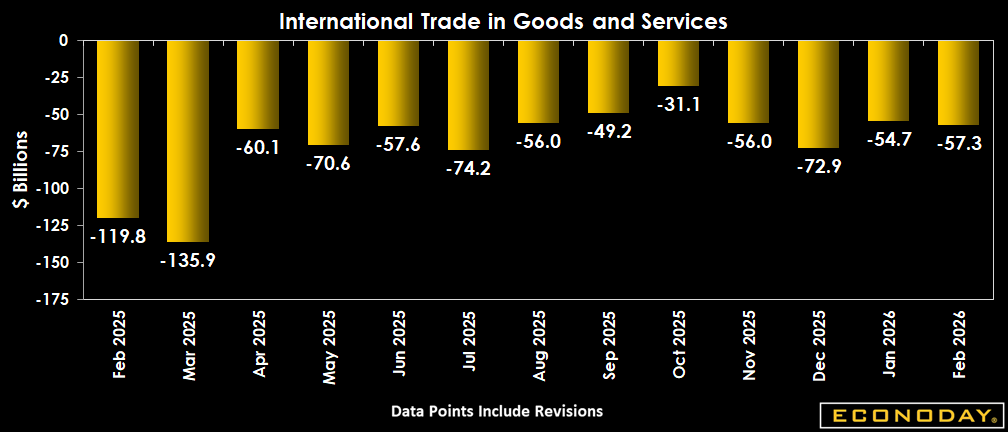
| Balance | $-60.1B | $-68.7B to $-45.0B | $-57.3B | $-54.5B | $-54.7B |
Highlights
February's trade data continue to reflect the impact of the capital investment boom linked to the massive build-up of AI infrastructure.
Imports jumped 4.3 percent from the prior month compared to a 4.2 percent rise in exports, resulting in a 4.9 percent increase in the trade gap. Demand for capital goods from abroad surged to the highest on record.
The international trade balance in goods and services jumped to a deficit of $57.3 billion in February from a deficit of $54.7 billion in January (previously reported as -$54.5 billion).
The February level is below the consensus of a deficit of $60.1 billion in the Econoday survey of forecasters.
The trade balance for goods-only is a deficit of $84.6 billion in February, compared to -$82.1 billion in January. The trade balance for services-only is a surplus of $27.3 billion in February, down from a $27.5 billion surplus in January.
February exports were $314.8 billion, $12.6 billion more than January ($302.2 billion) and the highest on record. February imports were $372.1 billion, $15.2 billion more than January ($356.9 billion). Year-to-date, the goods and services deficit decreased $136.1 billion, or -54.8 percent, from the same period in 2025. Exports increased $62.6 billion or 11.3 percent. Imports declined $73.5 billion or 9.2 percent.
Good exports rose from $195.4 billion in January to $206.9 billion in February, the highest on record. Exports of services went from $106.8 billion in January to $107.9 billion in February. Good imports jumped from $277.5 billion in January to $291.5 billion in February. Imports of services went from $79.4 billion in January to $80.6 billion in February, the highest on record.
February imports of capital goods ($118.5 billion) were the highest on record, as were exports of industrial supplies and materials ($81.8 billion) and non-petroleum exports ($185.7 billion).
Market Consensus Before Announcement
The trade gap is expected a bit wider at $60.1 billion in February from $54.5 billion in January. This one is hard to forecast given tariff effects.
Definition
Updating the goods portion of the advance report and offering initial data on services, this report provides complete information on cross-border trade. Merchandise trade is available by export, import and trade balance for six principal end-use commodity categories and for more than one hundred principal commodity groupings. Data are also available for 48 countries and 7 geographic regions. Detailed information is reported on oil and motor vehicle imports. Services trade is available by export, import and trade balance for seven principal end-use categories.
Description
Changes in the level of imports and exports, along with the difference between the two (the trade balance) are a valuable gauge of economic trends here and abroad. While these trade figures can directly impact all financial markets, they primarily affect the value of the dollar in the foreign exchange market.
Imports indicate demand for foreign goods and services here in the U.S. Exports show the demand for U.S. goods in countries overseas. The dollar can be particularly sensitive to changes in the chronic trade deficit run by the United States, since this trade imbalance creates greater demand for foreign currencies. The bond market is also sensitive to the risk of importing inflation. This report gives a breakdown of U.S. trade with major countries as well, so it can be instructive for investors who are interested in diversifying globally. For example, a trend of accelerating exports to a particular country might signal economic strength and investment opportunities in that country.
Importance
The international trade balance on goods and services is the major indicator for foreign trade. While the trade balance (deficit) is small relative to the size of the economy (although it has increased over the years), changes in the trade balance can be quite substantial relative to changes in economic output from one quarter to the next.
Interpretation
Market reaction to this report is complex. Typically, the smaller the trade deficit, the more bullish for the dollar. Also, stronger exports are bullish for corporate earnings and the stock market.
Both the level and changes in the level of international trade indicate relevant information about the trends in foreign trade. Like most economic indicators, the trade balance is subject to substantial monthly variability, especially when oil prices change. It is more appropriate to follow either three-month or 12-month moving averages of the monthly levels.
It is also useful to examine the trend growth rates for exports and imports separately because they can deviate significantly. Trends in export activity reflect both the competitive position of American industry and the strength of domestic and foreign economic activity. U.S. exports will grow when: 1) U.S. product prices are lower than foreign product prices; 2) the value of the dollar is relatively weaker than that of foreign currencies; 3) foreign economies are growing rapidly.
Imports will increase when: 1) foreign product prices are lower than prices of domestically-produced goods; 2) the value of the dollar is stronger than that of other currencies; 3) domestic demand for goods and services is robust.
The international trade report does show bilateral trade balances with our major trading partners. Since the value of the dollar versus various foreign currencies does not always move in tandem, we can see a narrower or wider trade deficit with different countries. In the 1980s and 1990s, the U.S. trade deficit with Japan often caused political problems. During the next 20 years the deficit with China began to grow rapidly and, like Japan, once again caused political problems. While American consumers benefit from weak imports, American workers often lose their jobs as these goods are no longer produced in the United States. Ideally, the United States would be exporting (high end) goods that other countries don't produce.