https://www.cmegroup.com/content/dam/cmegroup/images/common/default/article-940x600.jpg

US: Import and Export Prices
| Consensus | Consensus Range | Actual | Previous | Revised | |
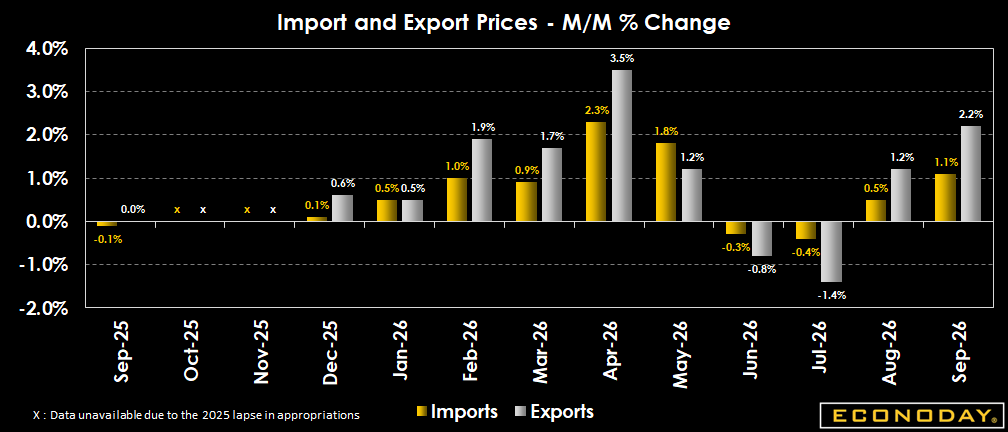
| Import Prices - M/M | 0.6% | 0.4% to 0.8% | 1.1% | 0.7% | 0.5% |
| Import Prices - Y/Y | 8.1% | 7.0% | 6.7% | ||
| Export Prices - M/M | 0.9% | 0.4% to 1.3% | 2.2% | 0.6% | 1.2% |
| Export Prices - Y/Y | 11.6% | 8.6% | 9.3% |
Highlights
Intensifying inflationary pressures also manifested in import prices in September, just as they did at the consumer and wholesale levels, continuing to put pressure on the Fed to act sooner rather than later. Import prices rose 1.1 percent in September, more than twice as much as the 0.5 percent estimate in August, topping expectations of 0.6 percent in an Econoday survey. Import prices were up 8.1 percent year-over-year, picking up from 6.7 percent in August and 6.0 percent in July, the largest increase since July 2022.
Fuel import prices rebounded 4.8 percent in September after three consecutive months of decreases, for a 12-month advace of 34.5 percent. Nonfuel price gains accelerated for the third consecutive month, to 0.7 percent from 0.6 percent in August, 0.3 percent in July and 0.1 percent in June. Nonfuel prices were up 6.0 percent from a year earlier.
Export price increases also accelerated, to a monthly pace of 2.2 percent in September from 1.2 percent the previous month, lifting the 12-month rate to 11.6 percent from 9.3 percent, the largest gain since July 2022. The highest forecast in Econoday's survey was 1.3 percent.
Agricultural export prices were up 2.6 percent in September, the largest gain since November 2022, for a year-over-year increase of 9.0 percent. Prices of exports excluding agriculture rose 2.1 percent on the month and 11.8 percent from September 2025.
Today's inflation report is the third this week to confirm that inflation picked up momentum in September. At the retail level, consumer prices were up 3.7 percent, compared to a 3.4 percent rise in August, with indication of inflationary pressures broadening beyond the energy sector, as core CPI, excluding food and energy, rose 2.6 percent, up from 2.4 percent in August.
Wholesale price gains picked up to 6.3 percentyear-over-year in September from 5.6 percent in August, the largest advance since December 2022, with a gains also accelerating when excluding food and energy.
Market Consensus Before Announcement
Import prices seen up 0.6 percent and export prices up 0.9 percent on month in September.
Definition
Import price indexes are compiled for the prices of goods that are bought in the United States but produced abroad and export price indexes are compiled for the prices of goods sold abroad but produced domestically. These prices, which exclude tariffs and taxes, measure underlying inflationary trends in internationally traded products.
Description
Changes in import and export prices are a valuable gauge of inflation here and abroad. Furthermore, the data can directly impact the financial markets such as bonds and the dollar. The bond market is especially sensitive to the risk of importing inflation because it erodes the value of the principal (the original investment) which is paid back when the bond matures. It also decreases the value of the steady stream of interest rate payments on this type of security. Inflation leads to higher interest rates and that's bad news for stocks, as well. By monitoring inflation gauges such as import prices, investors can keep an eye on this menace to their portfolios.