https://www.cmegroup.com/content/dam/cmegroup/images/common/default/article-940x600.jpg

US: Import and Export Prices
| Consensus | Consensus Range | Actual | Previous | Revised | |
| Import Prices - M/M | 2.1% | 0.4% to 2.9% | 0.8% | 1.3% | 0.9% |
| Import Prices - Y/Y | 2.1% | 1.3% | |||
| Export Prices - M/M | 1.7% | 1.0% to 3.2% | 1.6% | 1.5% | 1.9% |
| Export Prices - Y/Y | 5.6% | 3.5% |
Highlights
March import price inflation came in lower than expected, but the rate is only 0.2 percent lower when excluding prices for imported fuel with continued inflationary pressure from tariffs as well as the high demand for the materials needed to build AI data centers.
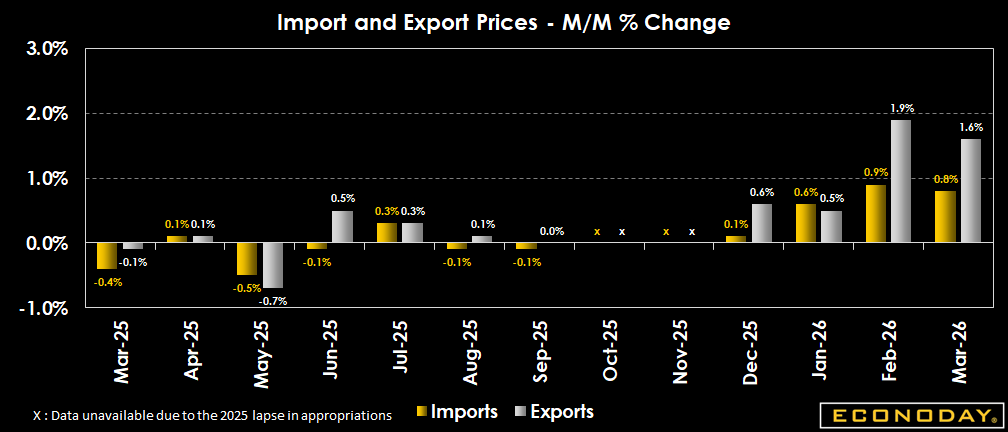
Prices for U.S. imports rose 0.8 percent in March following a revised 0.9-percent rise the previous month (previously +1.3 percent). Expectations were for a 2.1 percent surge in the Econoday survey of forecasters. Not surprisingly, higher fuel import prices were the primary driver of the increase.
U.S. import prices increased 2.1 percent compared to March 2025. This is the largest annual rise since prices spiked 2.2 percent in December 2024.
Nonfuel import prices rose 0.6 percent in March, following a 0.8 percent jump the previous month. Higher prices for nonfuel industrial supplies and materials; capital goods; consumer goods excluding automotives; and foods, feeds, and beverages drove the increase, the BLS said.
Import prices for nonfuel industrial supplies and materials rose 1.6 percent in March, after a 2.2 percent jump in February. Import prices for capital goods increased 0.5 percent, slowing down from +1.3 percent in February.
Import prices for automotive vehicles were unchanged in March, following a 0.1 percent uptick in February. Import prices for consumer goods (excluding autos) increased 0.4 percent in March, following a 0.2 percent rise in February.
Prices for nonfuel imports rose 2.8 percent over the past year, after a +2.5 percent jump in February, the biggest increase since October 2022 (+2.9 percent).
Prices for imported fuel saw a 2.9 percent surge in March, after a 2.4-percent spike in February, but plunged 6.0 percent compared to a year ago. Rising prices for petroleum powered the increase. Prices for import petroleum and petroleum products jumped 9.4 percent but are down 4.2 percent compared to March 2025.
The prices for U.S. exports were up 1.6 percent in March, following a +1.9 percent pace reported for the previous month.
Given March's large monthly increase, U.S. export prices rose by 5.6 percent over the past year.
Market Consensus Before Announcement
The consensus sees rising fuel costs lifting import prices by 2.1 percent and export prices by 1.7 percent on the month!
Definition
Import price indexes are compiled for the prices of goods that are bought in the United States but produced abroad and export price indexes are compiled for the prices of goods sold abroad but produced domestically. These prices, which exclude tariffs and taxes, measure underlying inflationary trends in internationally traded products.
Description
Changes in import and export prices are a valuable gauge of inflation here and abroad. Furthermore, the data can directly impact the financial markets such as bonds and the dollar. The bond market is especially sensitive to the risk of importing inflation because it erodes the value of the principal (the original investment) which is paid back when the bond matures. It also decreases the value of the steady stream of interest rate payments on this type of security. Inflation leads to higher interest rates and that's bad news for stocks, as well. By monitoring inflation gauges such as import prices, investors can keep an eye on this menace to their portfolios.