https://www.cmegroup.com/content/dam/cmegroup/images/common/default/article-940x600.jpg

US: Import and Export Prices
| Actual | Previous | |
| Import Prices - Y/Y | 0.0% | 0.1% |
| Export Prices - Y/Y | 3.1% | 3.3% |
Highlights
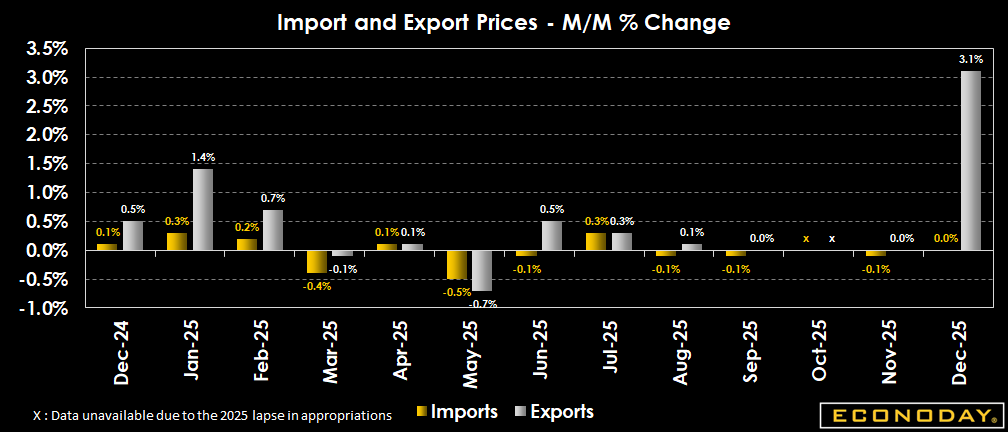
Import prices are up 0.1 percent on the month in December while export prices are up 0.3 percent. That compares with increases of 0.1 percent expected for both in the Econoday consensus forecast.
On year, import prices are flat while export prices are up 3.1 percent. That is all the information provided by the Department of Labor in releasing the report. It says the shutdown was to blame for lack of information and said it would not provide it later. Here is the statement in lieu of the usual report:
"As a result of the lapse in appropriations from October 1, 2025, through November 12, 2025, some U.S. Import and Export Price Index (MXP) values for October 2025 are permanently suppressed for publication.
For additional information see www.bls.gov/mxp/notices/2026/availability-of-oct-2025-mxpi-in-bls-database.htm.
The effects of the 2025 government shutdown will continue to delay publication of MXP data releases. Revised MXP release dates will be posted at www.bls.gov/bls/2025-lapse-revised-release-dates.htm as they
become available.
The lapse in appropriations from January 31, 2026, through February 3, 2026, did not affect data collection for price indexes."
______________________________________________________________________________________________________________
Market Consensus Before Announcement
The consensus sees import prices and export prices both up 0.1 percent on the month.
Definition
Import price indexes are compiled for the prices of goods that are bought in the United States but produced abroad and export price indexes are compiled for the prices of goods sold abroad but produced domestically. These prices, which exclude tariffs and taxes, measure underlying inflationary trends in internationally traded products.
Description
Changes in import and export prices are a valuable gauge of inflation here and abroad. Furthermore, the data can directly impact the financial markets such as bonds and the dollar. The bond market is especially sensitive to the risk of importing inflation because it erodes the value of the principal (the original investment) which is paid back when the bond matures. It also decreases the value of the steady stream of interest rate payments on this type of security. Inflation leads to higher interest rates and that's bad news for stocks, as well. By monitoring inflation gauges such as import prices, investors can keep an eye on this menace to their portfolios.