https://www.cmegroup.com/content/dam/cmegroup/images/common/default/article-940x600.jpg

US: Housing Starts and Permits
| Consensus | Consensus Range | Actual | Previous | |
| Starts - Annual Rate | 1.310M | 1.290M to 1.350M | 1.404M | 1.246M |
| Permits - Annual Rate | 1.400M | 1.310M to 1.425M | 1.448M | 1.412M |
Highlights
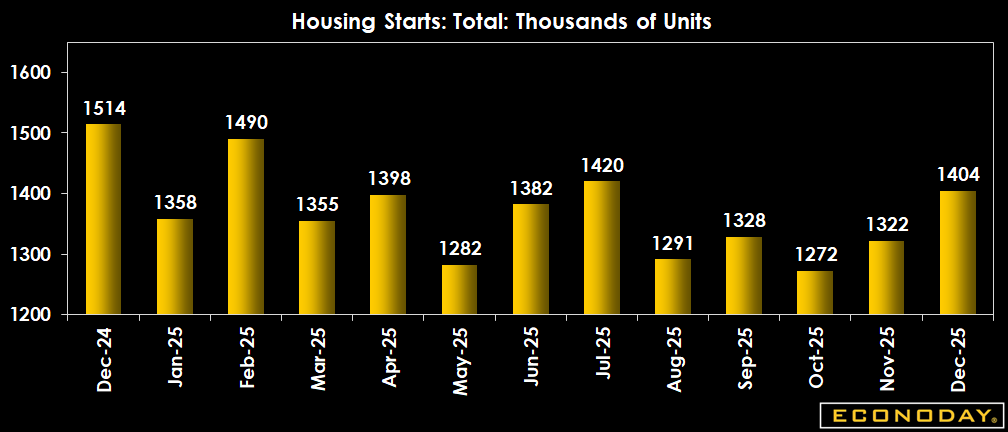
While the levels of starts and building permits are higher than expected in December from November, the year-over-year decrease points to a softer pace of construction for new homes. Declining mortgage rates helped lift demand for new homes in November and December. However, potential homebuyers are wary of entering the market. The issue of affordability is one of price as well as borrowing costs. Consumers are displaying recession-level low confidence and will be reluctant to commit to a home purchase in an uncertain economic environment with consequent concerns about job security.
Housing starts are up 6.2 percent in December to a 1.404 million unit seasonally adjusted annual pace after 1.322 million units in November. Starts are down 7.3 percent compared to a year ago. The December level is below the consensus of 1.310 million units in the Econoday survey of forecasters.
The increase reflects a 4.1 percent rise in single-family home starts to 981,000 units after 942,00 in November but is down 9.0 percent compared to December 2024. Multi-unit starts are 11.3 percent higher in December to 423,000 from 380,000 in November but down 3.0 percent a year ago. Construction of single-family homes has dipped as supplies of existing units have improved. Increases in multi-unit starts suggests that some homebuyers are opting for smaller townhouses which can be more affordable for entry level buyers.
Permits issued in December are up 4.3 percent to 1.448 million units after 1.388 million units in November and is down 2.2 percent compared to a year ago. December is not materially higher than the consensus of1.400 million units in the Econoday survey.
The December increase is entirely due to a jump of 15.2 percent in multi-unit permits to 567,000 from 492,000 in November and is up 15.5 percent compared to December 2024. Single-family permits-issued are down 1.7 percent to 881,000 in December after 896,000 in November and off 10.9 percent compared to a year earlier.
Market Consensus Before Announcement
Forecasters see December starts at 1.31 million rate and permits at 1.40 million. The Census Bureau is scheduled to release the delayed November report at the same time as December’s.
* Originally scheduled for 1/21/2026
Definition
Housing starts measure the initial construction of single-family and multi-family units on a monthly basis. Data on permits provide indications of future construction. A housing start is registered at the start of construction of a new building intended primarily as a residential building. The start of construction is defined as the beginning of excavation of the foundation for the building.
Description
Two words: Ripple Effect. This narrow piece of data has a powerful multiplier effect through the economy, and therefore across the markets and your investments. By tracking economic data such as housing starts, investors can gain specific investment ideas as well as broad guidance for managing a portfolio.
Home builders usually don't start a house unless they are fairly confident it will sell upon or before its completion. Changes in the rate of housing starts tell us a lot about demand for homes and the outlook for the construction industry. Furthermore, each time a new home is started, construction employment rises, and income will be pumped back into the economy. Once the home is sold, it generates revenues for the home builder and a myriad of consumption opportunities for the buyer. Refrigerators, washers and dryers, furniture, and landscaping are just a few things new home buyers might spend money on, so the economic"ripple effect" can be substantial especially when you think of it in terms of more than a hundred thousand new households around the country doing this every month.
Since the economic backdrop is the most pervasive influence on financial markets, housing starts have a direct bearing on stocks, bonds and commodities. In a more specific sense, trends in the housing starts data carry valuable clues for the stocks of home builders, mortgage lenders, and home furnishings companies. Commodity prices such as lumber are also very sensitive to housing industry trends.
Importance
The housing starts report is the most closely followed report on the housing sector. Housing starts reflect the commitment of builders to new construction activity. Purchases of household furnishings and appliances quickly follow.
Interpretation
The bond market will rally when housing starts decrease, but bond prices will fall when housing starts post healthy gains. A strong housing market is bullish for the stock market because the ripple effect of housing to consumer durable purchases spurs corporate profits. In turn, low interest rates encourage housing construction.
The level as well as changes in housing starts reveals residential construction trends. Housing starts are subject to substantial monthly volatility, especially during winter months. It takes several months to establish a trend. Thus, it is useful to look at a 5-month moving average (centered) of housing starts.
It is useful to examine the trends in construction activity for single homes and multi-family units separately because they can deviate significantly. Single-family home-building is larger and less volatile than multi-family construction. It is more sensitive to interest rate changes and less speculative in nature. The construction of multi-family units can be substantially influenced by changes in the tax code and speculative real estate investors.
Housing construction varies by region as well. The regions of the United States do not all follow exactly the same economic patterns because industry concentration varies in the four major regions of the country. The regional dispersion can mask underlying trends. The total level of housing construction as well as the regional distribution of housing construction is important.
Housing permits are released together with housing starts every month and are considered a leading indicator of starts. In reality, housing permits and starts typically move in tandem each month. However, there are some exceptions. For instance, if permits are issued late in the month, and weather does not permit immediate excavation, then permits might lead starts. For the most part, though, permits are not a good predictor of future housing starts. Incidentally, housing permits (but not starts) are one of the ten components of the index of leading indicators compiled by The Conference Board.