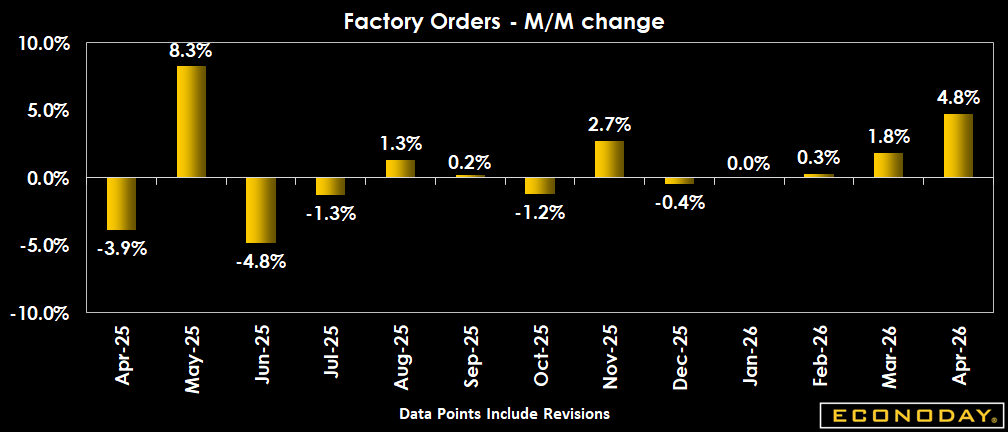
| Consensus | Consensus Range | Actual | Previous | Revised | |
| Month over Month | 4.3% | 0.3% to 5.5% | 4.8% | 1.5% | 1.8% |
Highlights
Orders up 4.8 percent on the month in April, topping the 4.3 percent consensus forecast. Orders are up a revised 1.8 percent in March, up from 1.5 percent previously reported.
Ex-transportation, orders are up 1.3 percent in April and 1.8 percent in March. Ex-defense, orders are up 4.7 percent in April and up 1.0 percent in March. The new durable goods figure is up 8.0 percent for April and up 1.3 percent in March. Nondurable goods orders are up 1.4 percent in April and 2.3 percent in March.
Market Consensus Before Announcement
After aircraft lifted durable goods orders by a huge 7.9 percent for April, factory orders are expected up by 4.3 percent as factory orders incorporates nondurables in addition to durables.
Definition
Factory orders represent the dollar level of new orders for both durable and nondurable goods. This report gives more complete information than the advance durable goods report which is released one or two weeks earlier in the month.
Description
Investors want to keep their fingers on the pulse of the economy because it usually dictates how various types of investments will perform. The stock market likes to see healthy economic growth because that translates to higher corporate profits. The bond market prefers more moderate growth which is less likely to cause inflationary pressures. By tracking economic data like factory orders, investors will know what the economic backdrop is for these markets and their portfolios. The orders data show how busy factories will be in coming months as manufacturers work to fill those orders. This report provides insight to the demand for not only hard goods such as refrigerators and cars, but nondurables such as cigarettes and apparel. In addition to new orders, analysts monitor unfilled orders, an indicator of the backlog in production. Shipments reveal current sales. Inventories give a handle on the strength of current and future production. All in all, this report tells investors what to expect from the manufacturing sector, a major component of the economy and therefore a major influence on their investments.