https://www.cmegroup.com/content/dam/cmegroup/images/common/default/article-940x600.jpg

US: Employment Situation
| Consensus | Consensus Range | Actual | Previous | Revised | |
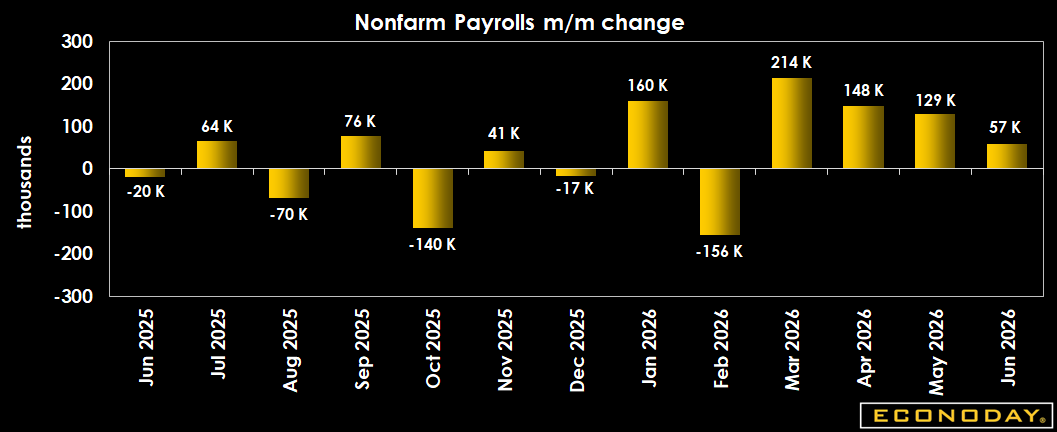
| Nonfarm Payrolls - M/M | 114,000 | 70,000 to 145,000 | 57,000 | 172,000 | 129,000 |
| Unemployment Rate | 4.3% | 4.3% to 4.5% | 4.2% | 4.3% | |
| Private Payrolls - M/M | 123,000 | 80,000 to 130,000 | 49,000 | 120,000 | 97,000 |
| Manufacturing Payrolls - M/M | 3,000 | 2,000 to 12,000 | 3,000 | 7,000 | -2,000 |
| Participation Rate | 61.8% | 61.7% to 61.9% | 61.5% | 61.8% | |
| Average Hourly Earnings - M/M | 0.3% | 0.2% to 0.3% | 0.3% | 0.3% | |
| Average Hourly Earnings - Y/Y | 3.5% | 3.4% to 3.5% | 3.5% | 3.4% | |
| Average Workweek | 34.3hrs | 34.2hrs to 34.3hrs | 34.3hrs | 34.3hrs |
Highlights
With a disappointing 57,000 jobs created in June, not even half what was expected by forecasters in an Econoday survey, the employment report made it that much harder to justify a rate hike to tame inflation, especially with a cumulative 74,000 downward revision to the previous two months. That being said, the latest FOMC's statement signaled the emphasis between the two mandates was on delivering price stability. The unemployment rate edged down to 4.2 percent from 4.3 percent, with the participation rate declining to 61.5 percent from 61.8 percent.
The April payroll estimate was revised down to 129,000 from 172,000 and the April estimate to 148,000 from 179,000. The three-month average is now at 111,000, down from 164,000 in May.
The average workweek was stable at 34.3 hours.
Private payrolls also disappointed with 49,000 jobs added in June after a downwardly revised 97,000 in May.
Average hourly earnings increased 0.3 percent on the month and 3.5 percent year-over-year, as expected, showing little sign of wage growth acceleration.
Looking at the sector breakdown, goods-producing industries added 10,000 jobs in June after 7,000 in May. Services added 39,000 jobs after 90,000.
Manufacturing employment increased 3,000 after declining 2,000 the previous month, down from the preliminary estimate of a 7,000 gain. Durable manufacturing was up 6,000, more than offsetting the 3,000 decline in nondurable. The construction sector added 11,000, while mining and logging was down 4,000.
Within services, private education and health services employment increased 69,000, including a 46,600 gain in health care and social assistance. Professional and business services added 36,000 jobs on the month. These gains were partly offset by a decline of 61,000 in leisure and hospitality even as the U.S. is one of the hosts of the soccer World Cup. Retail trade also shed jobs, which were down 7,500.
Market Consensus Before Announcement
A moderate 114K increase in payrolls is the call with the jobless rate flat at 4.3%.
Definition
The most closely watched of all economic indicators, the employment situation is a set of monthly labor market indicators based on two separate reports: the establishment survey which tracks 650,000 worksites and offers the nonfarm payroll and average hourly earnings headlines and the household survey which interviews 60,000 households and generates the unemployment rate.
Nonfarm payrolls track the number of part-time and full-time employees in both business and government. Average hourly earnings track employee pay while the average workweek, also part of the establishment survey, tracks the number of hours worked. The report's private payroll measure excludes government workers.
The unemployment rate measures the number of unemployed as a percentage of the labor force. In order to be counted as unemployed, one must be actively looking for work. Other commonly known data from the household survey include the labor supply and discouraged workers.
Description
If ever there was an economic report that can move the markets, this is it! The anticipation on Wall Street each month is palpable, the reactions can be dramatic, and the information for investors is invaluable. By digging just a little deeper than the headline unemployment rate, investors can take more strategic control of their portfolio and even take advantage of unique investment opportunities that often arise in the days surrounding this report.
The employment data give the most comprehensive report on how many people are looking for jobs, how many have them, what they're getting paid and how many hours they are working. These numbers are the best way to gauge the current state as well as the future direction of the economy. Nonfarm payrolls are categorized by sectors. This sector data can go a long way in helping investors determine in which economic sectors they intend to invest.
The employment statistics also provide insight on wage trends, and wage inflation is high on the list of opponents of easy monetary policy. Fed officials constantly monitor this data watching for even the smallest signs of potential inflationary pressures, even when economic conditions are soggy. If inflation is under control, it is easier for the Fed to maintain a more accommodative monetary policy. If inflation is a problem, the Fed is limited in providing economic stimulus.
By tracking the jobs data, investors can sense the degree of tightness in the job market. If wage inflation threatens, it's a good bet that interest rates will rise; bond and stock prices will fall. No doubt that the only investors in a good mood will be the ones who watched the employment report and adjusted their portfolios to anticipate these events. In contrast, when job growth is slow or negative, then interest rates are likely to decline - boosting up bond and stock prices in the process.
Importance
The employment situation is the primary monthly indicator of aggregate economic activity because it encompasses all major sectors of the economy. It is comprehensive and available early in the month. Many other economic indicators are dependent upon its information. It not only reveals information about the labor market, but about income and production as well. In short, it provides clues about other economic indicators reported for the month and plays a big role in influencing financial market psychology during the month. Additionally, the Fed has made 6.5 percent unemployment a threshold for considering changes in policy - both for quantitative easing and the fed funds rate. And the Fed has emphasized that it is overall labor market conditions that matter - not just a specific number.
Interpretation
The bond market will rally (fall) when the employment situation shows weakness (strength). The equity market often rallies with the bond market on weak data because low interest rates are good for stocks. But sometimes the two markets move in opposite directions. After all, a healthy labor market should be favorable for the stock market because it supports economic growth and corporate profits. At the same time, bond traders are more concerned about the potential for inflationary pressures.
The unemployment rate rises during cyclical downturns and falls during periods of rapid economic growth. A rising unemployment rate is associated with a weak or contracting economy and declining interest rates. Conversely, a decreasing unemployment rate is associated with an expanding economy and potentially rising interest rates. The fear is that wages will accelerate if the unemployment rate becomes too low and workers are hard to find.
Nonfarm payroll employment indicates the current level of economic activity. Increases in nonfarm payrolls translate into earnings that workers will spend on goods and services in the economy. The greater the increase in employment, the faster is the total economic growth. When the economy is in the mature phase of an expansion, rapid increases in employment cause fears of inflationary pressures if rapid demand for goods and services cannot be met by current production.
When the average workweek trends up, it supports production gains in the current period and portends additional employment increases. When the average workweek is in a declining mode, it probably is signaling a potential slowdown in employment growth-or even outright declines in employment in case of recession.
Gains in average hourly earnings represent wage pressures. It is worth noting that these figures aren't adjusted for overtime pay or shifts in the composition of the workforce, which affects wages on its own. Market participants believe that a rising trend in hourly earnings will lead to higher inflation. But if increased wages are matched by productivity gains, producers likely will not increase product prices with wages because their unit labor costs are stable.