| Consensus | Consensus Range | Actual | Previous | Revised | |
| CPI - M/M | 0.3% | 0.2% to 0.4% | 0.3% | 0.2% | 0.3% |
| CPI - Y/Y | 2.6% | 2.6% to 2.7% | 2.7% | 2.7% | |
| Ex-Food & Energy- M/M | 0.3% | 0.2% to 0.4% | 0.2% | 0.2% | |
| Ex-Food & Energy- Y/Y | 2.7% | 2.6% to 2.8% | 2.6% | 2.6% |
Highlights
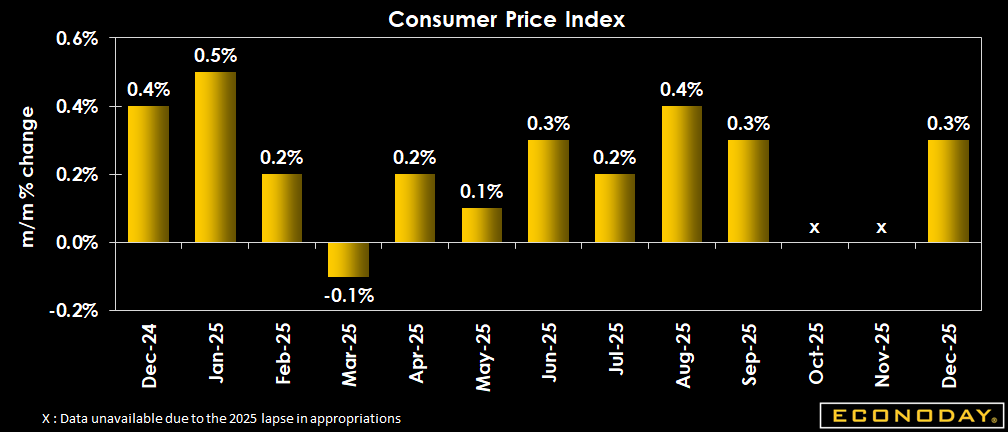
The December CPI report on the surface shows a slight reversal in the decelerating pace of consumer price increases seen in prior reports, although the core headline number came in below expectations. However, the disruption to data collection caused by the prolonged federal government shutdown means there are no monthly inflation numbers for October and November.
A spike in shelter costs drove the overall monthly increase, and sustained price inflation in that category will further limit the number of rate cuts by the Federal Reserve rate in 2026. The elevated level of services price inflation excluding energy (+3.0 percent) should temper expectations for aggressive monetary policy easing.
The Consumer Price Index in December sped up by 0.3 percent, matching the pace set in September (revised up from +0.2 percent). The December CPI reading met expectations for a 0.3 percent rise in the Econoday survey of forecasters.
Over the last 12 months, consumer prices are up 2.7 percent, the same rise as in November. Expectations in the Econoday survey were for a 2.6 percent increase.
Core CPI, excluding food and energy prices, is up 0.2 percent in December, following a 0.2 percent uptick in September. Consumer prices less food and energy rose 2.6 percent from December 2024, following a 2.6 percent year-over-year rise in November and 2.7 percent expected in the Econoday survey.
After a 0.2 percent rise in September, shelter costs jumped 0.4 percent in December (and are up 3.2 percent year-over-year). Food prices rose 0.7 percent, after a 0.2 percent bump in September. Grocery prices are up 0.7 percent on a monthly basis in December and +2.4 percent compared to a year ago, and restaurant prices also rose 0.7 percent and surged 4.1 percent compared to December 2024.
Food prices overall increased by 3.1 percent compared to December 2024, following a 2.6 percent rise in November.
Energy costs rose 0.3 percent, following a 1.5 percent jump in September boosted by a 4.4 percent spike in natural gas prices.
Energy prices are up 2.3 percent year-over-year, following a 4.2 percent spike for the 12 months ending November.
Market Consensus Before Announcement
CPI for December expected up 0.3 percent for total and up 0.3 percent core. On year, the call is up 2.6 percent and up 2.7 percent core.
Definition
The CPI is a measure of the change in the average price level of a fixed basket of goods and services purchased by consumers. Monthly changes in the CPI represent the rate of inflation for the consumer. Annual inflation is also closely watched.
The consumer price index is available nationally by expenditure category and by commodity and service group for all urban consumers (CPI-U) and wage earners (CPI-W). All urban consumers are a more inclusive group. The CPI-U is the more widely quoted of the two, although cost-of-living contracts for unions and Social Security benefits are usually tied to the CPI-W, because it has a longer history. Monthly variations between the two are slight.
The CPI is also available by size of city, by region of the country, for cross-classifications of regions and population-size classes, and for many metropolitan areas. The regional and city CPIs are often used in local contracts.
The Bureau of Labor Statistics also produces a chain-weighted index called the Chained CPI. This measures a variable basket of goods and services whereas the regular CPI-U and CPI-W measure a fixed basket of goods and services. The Chained CPI is similar to the personal consumption expenditure price index that is closely monitored by the Federal Reserve Board.
Description
The consumer price index is the most widely followed monthly indicator of inflation. An investor who understands how inflation influences the markets will benefit over those investors that do not understand the impact.
Inflation is an increase in the overall prices of goods and services. The relationship between inflation and interest rates is the key to understanding how indicators such as the CPI influence the markets- and your investments.
If someone borrows $100 dollars from you today and promises to repay it in one year with interest, how much interest should you charge? The answer depends largely on inflation as you know the $100 will not be able to buy the same amount of goods and services a year from now. The CPI tells us that prices rose 4.2 percent in the U.S. over 2007. To recoup your purchasing power, you would have to charge 4.2 percent interest. You might want to add one or two percentage points to cover default and other risks, but inflation remains the key factor behind the interest rate you charge.
Inflation (along with various risks) basically explains how interest rates are set on everything from your mortgage and auto loans to Treasury bills, notes and bonds. As the rate of inflation changes and as expectations on inflation change, the markets adjust interest rates. The effect ripples across stocks, bonds, commodities, and your portfolio, often in a dramatic fashion.