| Consensus | Consensus Range | Actual | Previous | |
| Index | 51.4 | 50.0 to 52.5 | 47.8 | 51.7 |
| Year-ahead Inflation Expectations | 4.6% | 4.0% | ||
| Index Change | -3.9 | 0.7 | ||
| Index % Change | -7.5% | 1.4% |
Highlights
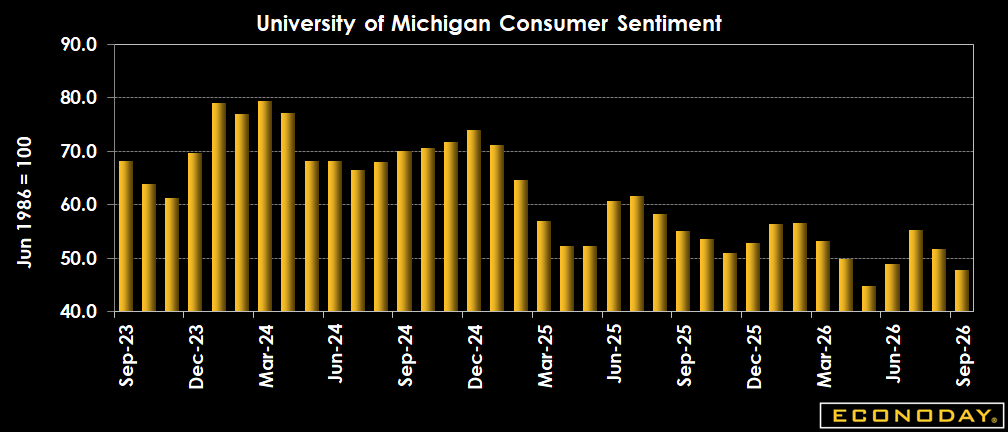
U.S. consumer sentiment took another step back this month, with September’s preliminary reading coming in at 47.8 vs. 51.7 in August and 55.2 in July. This is below the consensus of 51.4 in the Econoday survey of forecasters. Consumer sentiment fell 7.5 percent, dragged down by inflation worries, financial concerns, and renewed trade hostilities with Canada.
Sentiment is down 13.2 percent from September 2025 as year-ahead expectations for both personal finances and business conditions plunged.
“With a resurgence in fuel prices and trade tensions, consumers anticipate greater pressures on their pocketbooks to come,” the report said.
“Five-year expected business conditions remained stable at readings well below their historical average,” it added, “suggesting that consumers believe that emerging risks this month may not have further worsened the long-run outlook.”
Preliminary year-ahead inflation expectations jumped to 4.6 percent in September from 4.0 percent in August. This significantly exceeds the 3.4 percent reading seen in February before the Iran conflict began, along with all 2024 readings, the report said.
Long-run inflation expectations in September rose to 3.4 percent from 3.3 percent last month, staying above the 2.8 percent to 3.2 percent range seen in 2024.
Market Consensus Before Announcement
Sentiment expected bleaker at 51.4 in September, down from 51.7 in August and 55.2 in July. Consumers remain upset about inflation.
Definition
The University of Michigan's Consumer Survey Center questions households each month on their assessment of current conditions and expectations of future conditions. Preliminary estimates for a month are released at mid-month and are based on about 420 respondents. Final estimates are released near the end of the month and are based on about 600 respondents.
Description
The pattern in consumer attitudes and spending is often the foremost influence on stock and bond markets. For stocks, strong economic growth translates to healthy corporate profits and higher stock prices. For bonds, the focus is whether economic growth goes overboard and leads to inflation. Ideally, the economy walks that fine line between strong growth and excessive (inflationary) growth.
This balance was achieved through much of the nineties and, in large part because of this, investors in the stock and bond markets enjoyed huge gains. It was during the late nineties that the consumer sentiment index hit its historic peak, reaching levels that were never matched during the subsequent 2001 to 2007 expansion nor during the long expansion following the Great Recession.
Consumer spending accounts for more than two-thirds of the economy, so the markets are always dying to know what consumers are up to and how they might behave in the near future. The more confident consumers are about the economy and their own personal finances, the more likely they are to spend. With this in mind, it's easy to see how this index of consumer attitudes gives insight to the direction of the economy. Just note that changes in consumer confidence and retail sales don't move in tandem month by month.