| Consensus | Consensus Range | Actual | Previous | |
| Index | 54.0 | 53.8 to 54.5 | 56.4 | 54.0 |
| Year-ahead Inflation Expectations | 4.0% | 4.2% |
Highlights
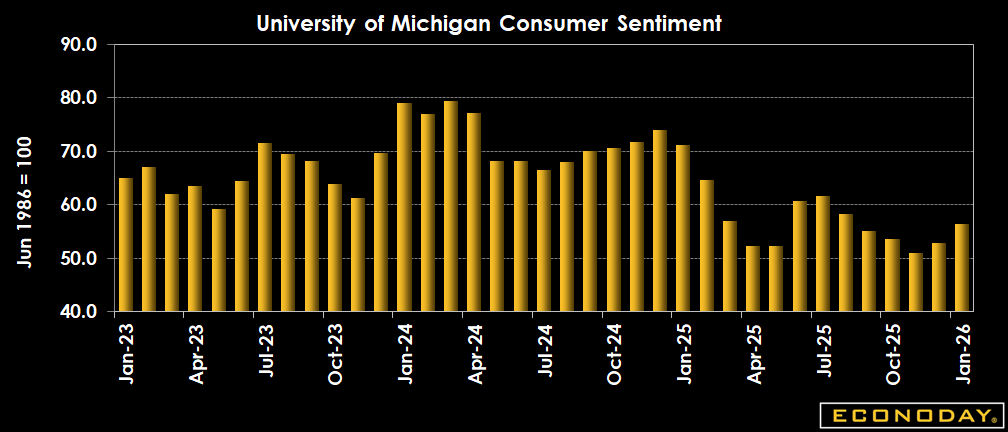
Consumer sentiment perked up in the latter part of January with the University of Michigan index up to 56.4, well above the 54.0 preliminary figure and up 6.6 percent from 52.9 in December, though the index is still down 21 percent from 71.7 in January 2025. The Econoday consensus looked for no revision in the January final report from the January preliminary index at 54.0.
Gains in sentiment were across demographics. Still it remains down sharply from a year ago as consumers remain broadly gloomy over high prices and continue to worry about a weakening job market.
Inflation expectations are down at 4.0 percent for the year ahead in the January final report, down from 4.2 percent in December. The 4.0 percent figure is the lowest since January 2025 but that month it was a lot lower at 3.3 percent. Five-year inflation expectations, on the other hand, are up at 3.3 percent in the final January report from 3.2 percent in December.
Market Consensus Before Announcement
No revision expected for the final January from the preliminary at 54.0.
Definition
The University of Michigan's Consumer Survey Center questions households each month on their assessment of current conditions and expectations of future conditions. Preliminary estimates for a month are released at mid-month and are based on about 420 respondents. Final estimates are released near the end of the month and are based on about 600 respondents.
Description
The pattern in consumer attitudes and spending is often the foremost influence on stock and bond markets. For stocks, strong economic growth translates to healthy corporate profits and higher stock prices. For bonds, the focus is whether economic growth goes overboard and leads to inflation. Ideally, the economy walks that fine line between strong growth and excessive (inflationary) growth.
This balance was achieved through much of the nineties and, in large part because of this, investors in the stock and bond markets enjoyed huge gains. It was during the late nineties that the consumer sentiment index hit its historic peak, reaching levels that were never matched during the subsequent 2001 to 2007 expansion nor during the long expansion following the Great Recession.
Consumer spending accounts for more than two-thirds of the economy, so the markets are always dying to know what consumers are up to and how they might behave in the near future. The more confident consumers are about the economy and their own personal finances, the more likely they are to spend. With this in mind, it's easy to see how this index of consumer attitudes gives insight to the direction of the economy. Just note that changes in consumer confidence and retail sales don't move in tandem month by month.