https://www.cmegroup.com/content/dam/cmegroup/images/common/default/article-940x600.jpg

US: Construction Spending
| Consensus | Consensus Range | Actual | Previous | Revised | |
| Month over Month | 0.5% | 0.1% to 0.6% | -1.9% | 0.9% | 2.0% |
| Year over Year | -2.7% | -1.7% | -0.7% |
Highlights
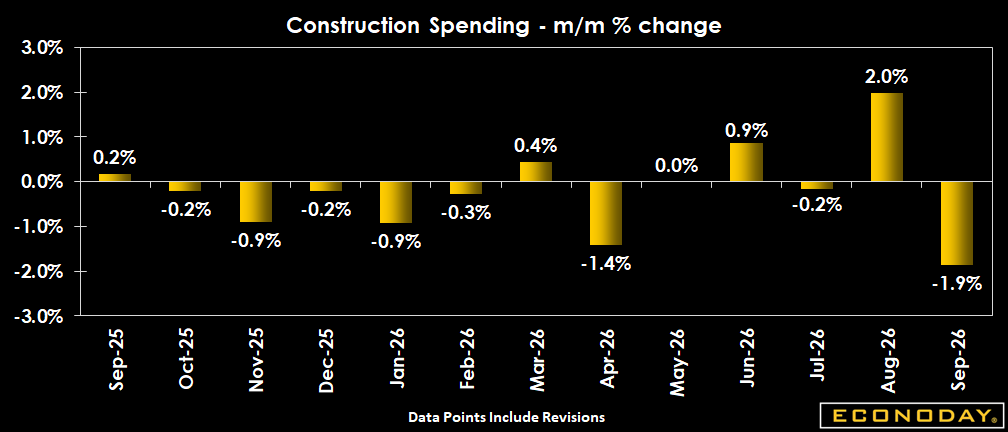
U.S. construction spending unexpectedly contracted in September, although the weakness was somewhat offset by an upward revision to the previous month.
Construction spending was down 1.9 percent from August, while forecasters in an Econoday survey had expected a 0.5 percent increase. However, the previous month growth is now estimated at 2.0 percent after being initially reported at 0.5 percent.
Construction spending declined 2.7 percent year-over-year amid ongoing headwinds from financing costs, materials inflation, tariffs, and weak housing. In September, U.S. homebuilder sentiment fell to its lowest level in a year, with builders also citing tight labor conditions in addition to costs and the economic outlook.
Construction spending was down in both the private and public sectors in September.
Private construction spending decreased 2.4 percent on the month, led by a 5.5 percent drop in the residential sector. In September, sales of new single-family houses contracted 0.6 percent while existing home sales were up 1.5 percent, suggesting that construction spending was more focused on home improvement than new home building.
By contrast, private nonresidential construction spending rose 1.1 percent, possibly benefiting from the build-out of data centers despite the public headlines showing growing opposition. Within the nonresidential sector, power was up 1.2 percent.
Public construction spending edged down 0.1 percent in September.
Market Consensus Before Announcement
Construction spending expected up 0.5 percent, a big increase for one month. That reflects the explosion in data center construction.
Definition
The dollar value of new construction activity on residential, non-residential, and public projects. Data are available in nominal and real (inflation-adjusted) dollars.
Description
Construction spending has a direct bearing on stocks, bonds and commodities because it is a part of the economy that is affected by interest rates, business cash flow and even federal fiscal policy. In a more specific sense, trends in the construction data carry valuable clues for the stocks of home builders and large-scale construction contractors. Commodity prices such as lumber are also very sensitive to housing industry trends.
Businesses only put money into the construction of new factories or offices when they are confident that demand is strong enough to justify the expansion. The same goes for individuals making the investment in a home.
A portion of construction spending is related to government projects such as education buildings as well a highways and streets. While investors are more concerned with private construction spending, the government projects put money in the hands of laborers who then have more money to spend on goods and services.
On a technical note, construction outlays for private residential, private nonresidential, and government are key inputs into three components of GDP--residential investment, nonresidential structures investment, and the structures portion of government expenditures.
That is why construction spending is a good indicator of the economy's momentum.