https://www.cmegroup.com/content/dam/cmegroup/images/common/default/article-940x600.jpg

US: Construction Spending
| Consensus | Consensus Range | Actual | Previous | Revised | |
| Month over Month | 0.3% | 0.1% to 0.7% | -0.3% | 0.3% | 0.8% |
| Year over Year | 1.0% | -0.4% |
Highlights
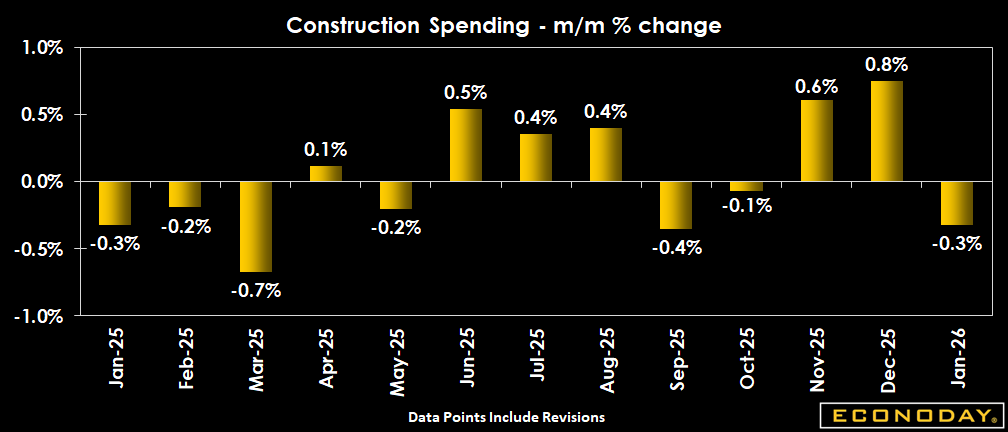
The January U.S. construction spending report showed activity contracted to start the year due to severe winter weather, although not enough to negate the rise in spending in the prior two months, and it came in at a higher level compared to January 2025.
U.S. construction spending declined unexpectedly in January, down 0.3 percent, vs. expectations for a 0.3 percent rise in the Econoday survey of forecasters. December saw a 0.8 percent increase (revised from +0.3 percent), following November's 0.6 percent rise.
The estimated level of construction spending in January is 1.0 percent higher than January 2025.
Private construction spending in January fell 0.6 percent from December. Residential construction spending contracted by 0.8 percent and non-residential shrank by 0.4 percent.
Private construction spending contracted by 0.1 percent from January 2025.
Public construction spending was up 0.6 percent from December.
Market Consensus Before Announcement
Spending is seen up 0.3 percent in January on month after rising by the same 0.3 percent in December.
* Originally scheduled for 3/2/2026
Definition
The dollar value of new construction activity on residential, non-residential, and public projects. Data are available in nominal and real (inflation-adjusted) dollars.
Description
Construction spending has a direct bearing on stocks, bonds and commodities because it is a part of the economy that is affected by interest rates, business cash flow and even federal fiscal policy. In a more specific sense, trends in the construction data carry valuable clues for the stocks of home builders and large-scale construction contractors. Commodity prices such as lumber are also very sensitive to housing industry trends.
Businesses only put money into the construction of new factories or offices when they are confident that demand is strong enough to justify the expansion. The same goes for individuals making the investment in a home.
A portion of construction spending is related to government projects such as education buildings as well a highways and streets. While investors are more concerned with private construction spending, the government projects put money in the hands of laborers who then have more money to spend on goods and services.
On a technical note, construction outlays for private residential, private nonresidential, and government are key inputs into three components of GDP--residential investment, nonresidential structures investment, and the structures portion of government expenditures.
That is why construction spending is a good indicator of the economy's momentum.