https://www.cmegroup.com/content/dam/cmegroup/images/common/default/article-940x600.jpg

US: Business Inventories
| Consensus | Consensus Range | Actual | Previous | Revised | |
| Month over Month | 0.5% | 0.3% to 0.7% | 0.5% | 0.9% | 1.0% |
| Manufacturing Inventories | 0.3% | 0.6% | 0.7% | ||
| Retail Inventories | 0.7% | 0.6% | 0.8% | ||
| Wholesale Inventories | 0.6% | 1.3% | 1.5% |
Highlights
U.S. business inventories were up 0.5 percent in April, in line with expectations in an Econoday survey, compared to an upwardly revised 1.0 percent increase in March. Business inventories rose 2.7 percent year-over-year.
Business sales growth slowed to 1.2 percent in April from 2.2 percent in March, for a 12-month gain of 8.7 percent.
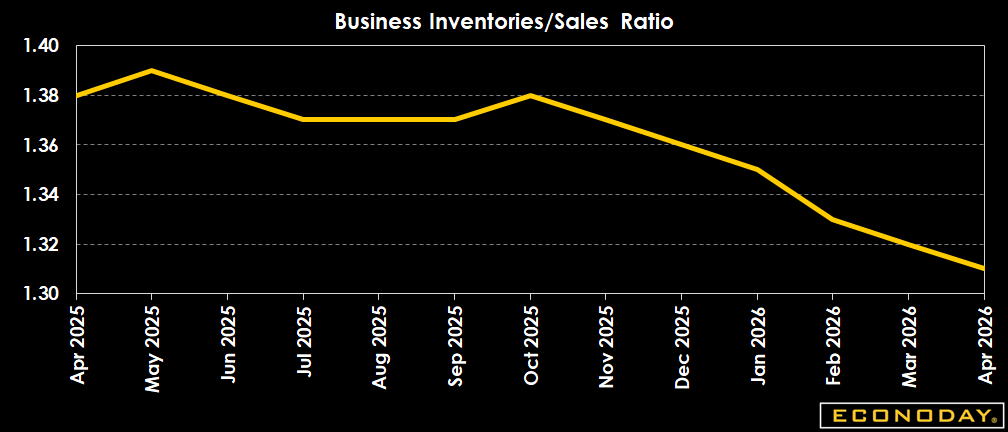
The total business inventories/sales ratio at the end of April edged down to 1.31 from 1.32 in March, and 1.38 a year earlier.
Manufacturers' sales were up 1.0 percent in April, while their inventories increased 0.3 percent. At retailers, sales expanded 0.3 percent and inventories 0.7 percent. Meanwhile, wholesalers saw a 2.0 percent increase in sales after 3.0 percent in March, with inventories up 0.6 percent in April.
Market Consensus Before Announcement
A strong 0.5 percent increase is expected for April after a big 0.9 percent in March.
Definition
Business inventories are the dollar amount of inventories held by manufacturers, wholesalers, and retailers. The level of inventories in relation to sales is an important indicator of the near-term direction of production activity.
Description
Investors need to monitor the economy closely because it usually dictates how various types of investments will perform. The stock market likes to see healthy economic growth because that translates to higher corporate profits. The bond market prefers more moderate growth that won't generate inflationary pressures.
Rising inventories can be an indication of business optimism that sales will be growing in the coming months. By looking at the ratio of inventories to sales, investors can see whether production demands will expand or contract in the near future. For example, if inventory growth lags sales growth, then manufacturers will have to boost production lest commodity shortages occur. On the other hand, if unintended inventory accumulation occurs (that is, sales do not meet expectations), then production will probably have to slow while those inventories are worked down. In this manner, the business inventory data provide a valuable forward-looking tool for tracking the economy.