| Recent History | |||||||
| On Feed | Placements | Marketings | On Feed | ||||
| Month | Million Head | % YoY | Million Head | % YoY | Million Head | % YoY | 90+ Days |
| Nov-24 | 11.966 | 100.1% | 1.796 | 96.3% | 1.725 | 98.5% | 5.733 |
| Dec-24 | 11.982 | 99.7% | 1.642 | 96.7% | 1.742 | 101.0% | 5.930 |
| Jan-25 | 11.823 | 99.1% | 1.822 | 101.7% | 1.869 | 101.4% | 6.288 |
| Feb-25 | 11.716 | 99.3% | 1.554 | 82.2% | 1.633 | 91.1% | 6.630 |
| Mar-25 | 11.577 | 97.8% | 1.843 | 105.2% | 1.727 | 101.2% | 6.738 |
| Apr-25 | 11.638 | 98.4% | 1.613 | 97.4% | 1.825 | 97.5% | 6.594 |
| May-25 | 11.376 | 98.5% | - | - | - | - | 6.531 |
| Cattle on Feed Estimates | |||||
| Estimates | |||||
| As Of | Average | Low | High | Last Year | |
| On Feed | May | 98.6% | 98.3% | 99.5% | 99.1% |
| Placements | Apr | 97.5% | 95.4% | 103.8% | 94.2% |
| Marketings | Apr | 96.7% | 96.0% | 97.4% | 110.1% |
Highlights
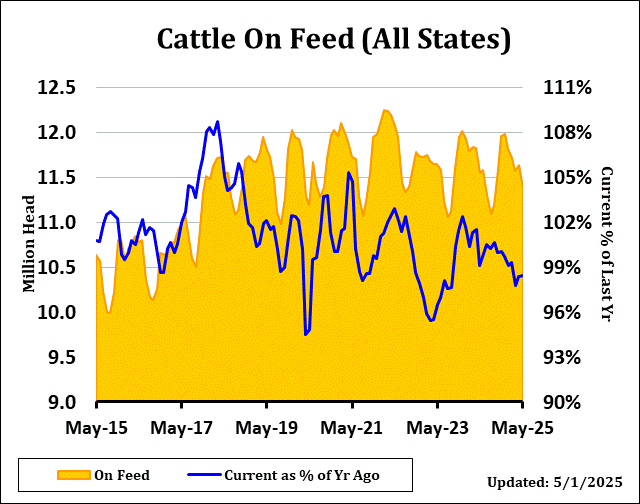
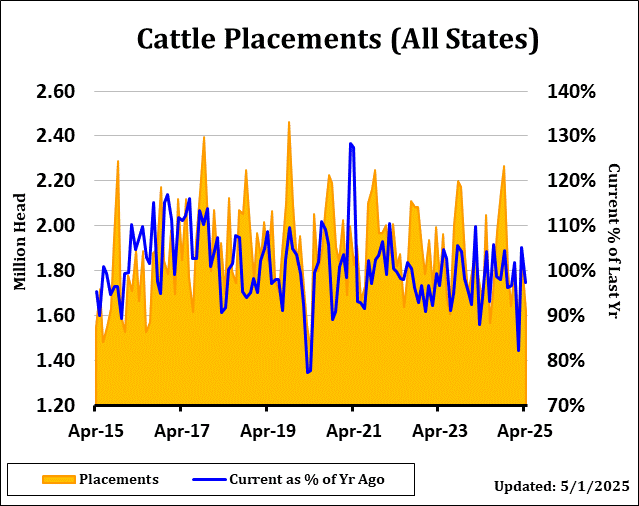
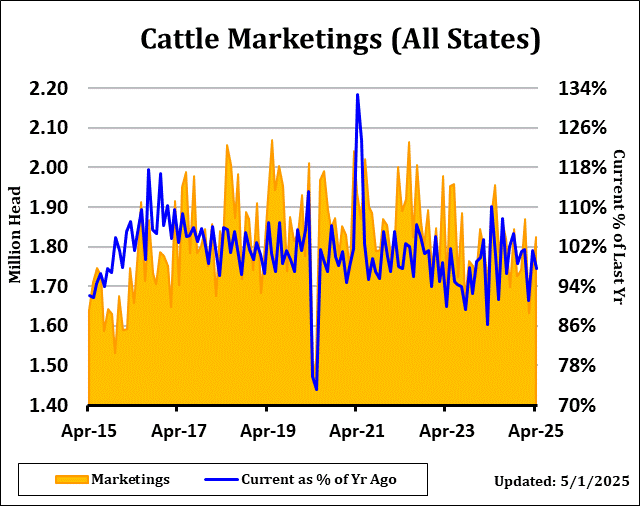
The USDA Cattle on Feed Report showed On Feed as of May 1st at 98.5% of last year versus a trade estimate of 98.6% (range 98.3% to 99.5%). Placements were 97.4% versus trade expectations of 97.5% (range 95.4% to 103.8%). Marketings were 97.5% of last year versus estimates of 96.7% (range 96.0% to 97.4%). All southern border states had lower cattle placed, likely due to fewer Mexican cattle imports.
US Beef in Cold Storage at the end of April fell 2% from the prior month to 418.15 million lbs, compared to 425.17 in March and 426.37 in April a year ago.
With only the marketing number deviating from pre-report estimates, the report is considered neutral and is unlikely to have a dramatic effect on Tuesday morning's opening. Traders will quickly turn their attention back to cash cattle trade next week. Both live cattle and feeder futures rallied this week to key retracement levels following the major reversal down last week. Cash cattle prices have not weakened significantly, mitigating the downside follow through from last week's bearish technical signal. Next week's cash prices will likely dictate whether the current rally can sustain or if last week's technical weakness signaled a top.
Definition
This file contains the monthly total number of cattle and calves on feed, placements, marketings, and other disappearances; by class and feedlot capacity for selected states; number of feedlots and fed cattle marketings by size groups for selected states. Data is organized by state and by U.S.
Description
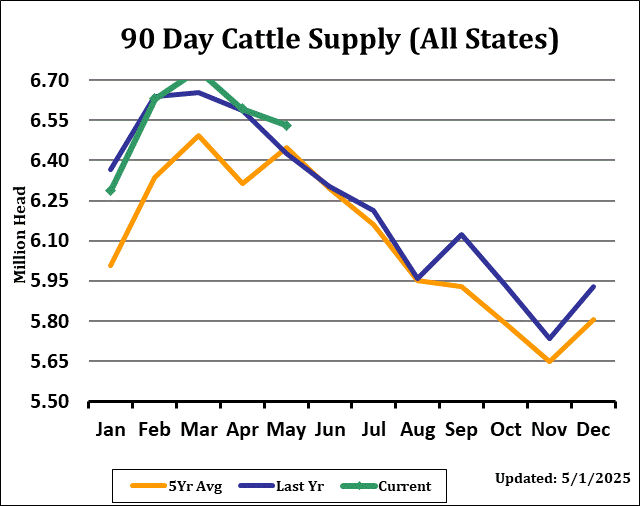
This report offers a timely update on the current makeup of the beef cattle herd. It is probably the most-watched of the USDA reports for the cattle markets and can be a market-moving event if it contains a surprise. The marketings number provides an indicator of recent demand and has the ability to affect the price of nearby futures contracts. The placements number offers insight on the future supply of market ready cattle and has a tendency to affect the deferred contracts. Cattle are placed on feed for anywhere from 90 to 180 days, so a large placements number in June would project large market-ready supply in the fall. Both the placements and the marketings numbers inform the on feed number, which is a measure of current supply. The report offers state-by-state breakdowns as well by various weight groupings, providing an opportunity for further, in-depth analysis. Cattle on Feed reports are usually released on Friday afternoons after the cattle futures market closes, and the results will be reflected on the opening the following Monday morning.