| Consensus | Consensus Range | Actual | Previous | |
| Index | 50.5 | 50.1 to 51.7 | 51.0 | 50.3 |
| Year-ahead Inflation Expectations | 4.5% | 4.7% |
Highlights
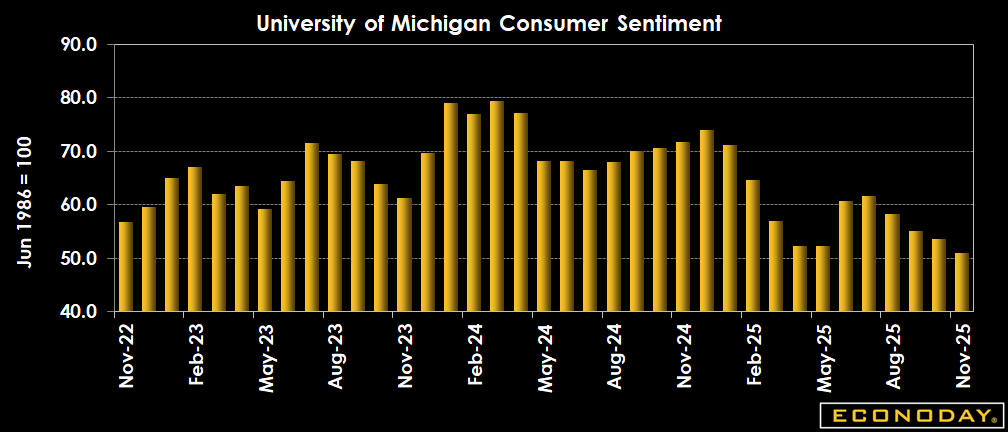
U.S. consumer sentiment declined this month, with November's final reading coming in at 51.0 (revised from 50.3) vs. 53.6 in October and 55.1 in September. This is better than the consensus of 50.5 in the Econoday survey of forecasters. Persistent high prices and incomes failing to keep up with inflation continue to affect sentiment.
After the federal shutdown ended, sentiment lifted slightly from its mid-month reading, the report noted. This month, current personal finances and buying conditions for durables both plunged more than 10%, whereas expectations for the future improved modestly.
The recent stock market correction is also having an impact, reversing the improvement in sentiment for consumers with the largest stock holdings seen at the preliminary reading.
Final year-ahead inflation expectations dipped to 4.5 percent in November, from 4.6 percent in October. This marks three consecutive months of declines, but short-run inflation expectations still remain above the 3.3% seen in January, the report said.
Long-run inflation expectations in November declined to 3.4 percent from 3.9 percent last month.
Despite these improvements in the future trajectory of inflation, consumers continue to report that their personal finances now are weighed down by the present state of high prices, the report said.
Market Consensus Before Announcement
The consensus looks for 50.5 in the November final versus the preliminary at 50.3, down from an already bleak 53.6 in October. Consumers continue to fret about losing their jobs and rising prices.
Definition
The University of Michigan's Consumer Survey Center questions households each month on their assessment of current conditions and expectations of future conditions. Preliminary estimates for a month are released at mid-month and are based on about 420 respondents. Final estimates are released near the end of the month and are based on about 600 respondents.
Description
The pattern in consumer attitudes and spending is often the foremost influence on stock and bond markets. For stocks, strong economic growth translates to healthy corporate profits and higher stock prices. For bonds, the focus is whether economic growth goes overboard and leads to inflation. Ideally, the economy walks that fine line between strong growth and excessive (inflationary) growth.
This balance was achieved through much of the nineties and, in large part because of this, investors in the stock and bond markets enjoyed huge gains. It was during the late nineties that the consumer sentiment index hit its historic peak, reaching levels that were never matched during the subsequent 2001 to 2007 expansion nor during the long expansion following the Great Recession.
Consumer spending accounts for more than two-thirds of the economy, so the markets are always dying to know what consumers are up to and how they might behave in the near future. The more confident consumers are about the economy and their own personal finances, the more likely they are to spend. With this in mind, it's easy to see how this index of consumer attitudes gives insight to the direction of the economy. Just note that changes in consumer confidence and retail sales don't move in tandem month by month.