https://www.cmegroup.com/content/dam/cmegroup/images/common/default/article-940x600.jpg

US: NFIB Small Business Optimism Index
| Consensus | Consensus Range | Actual | Previous | |
| Index | 98.7 | 98.0 to 99.0 | 98.6 | 98.8 |
Highlights
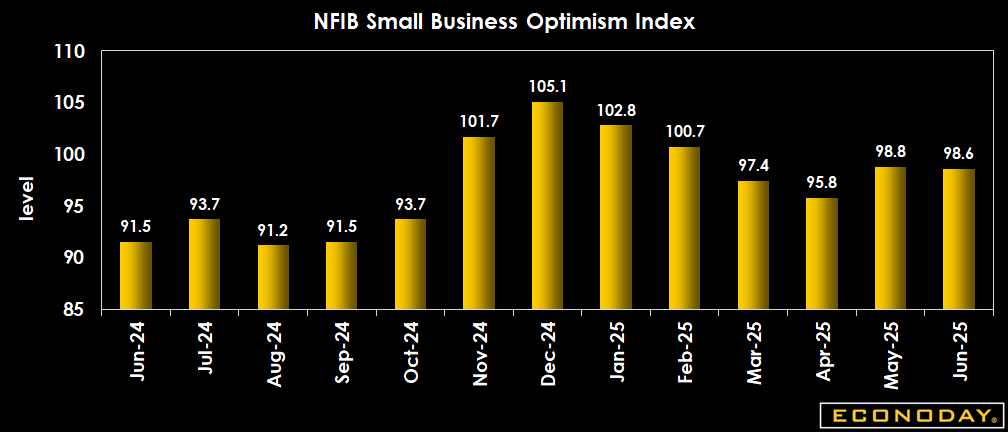
The NFIB small business optimism index is essentially unchanged at 98.6 in June after 98.8 in May, and virtually the same as the consensus of 98.7 in the Econoday survey of forecasters. The index remains above the 51-year average of 98 for a second month in a row. The optimism index is less volatile now that some of the chaotic roll out of tariffs settled in May and June. The uncertainty index is down 5 points to 89 in June, although it remains elevated.
Among the 10 index components, 4 are higher, 4 are lower, and 2 are unchanged in June. The largest increase is 4 points in the earnings trend, although it remains negative at minus 22 percent. The largest decrease is 6 points in current inventories to minus 5 percent after briefly turning higher to positive 1 percent in May.
The forward-looking components of expectations for the economy to improve and higher sales are both down 3 points to 22 percent and 7 percent, respectively. There does not appear to be much upward momentum for the index.
The single most important problem cited by survey respondents in June is taxes at 19 percent. This is likely the result of higher tariffs and/or anticipation of higher tariffs. This is the largest reading since 19 percent in July 2021. Inflation was cited by 11 percent of respondents in June, down from 14 percent in May. While the job market was hot, quality of labor kept pace with worries about inflation. In June, it is down to 16 percent for the second month in a row now that the supply of labor is more plentiful.
Market Consensus Before Announcement
The index is expected nearly flat at 98.7 in June from 98.8 in May in June. The index was up 3.0 points to 98.8 in May as sentiment recovered from the tariff shock in April.
Definition
The small business optimism index is compiled from a survey that is conducted each month by the National Federation of Independent Business (NFIB) of its members. The index is a composite of 10 seasonally adjusted components based on the following questions: plans to increase employment, plans to make capital outlays, plans to increase inventories, expect economy to improve, expect real sales higher, current inventory, current job openings, expected credit conditions, now a good time to expand, and earnings trend.
Description
Small businesses are responsible for a majority of new job creation and the NFIB focuses on this sector of the economy. The direction of the health of small businesses can portend changes in the stock market - especially small caps.