Understanding Equity Index Sector futures
Investors understand that the economy is comprised of various sectors. Of course, some sectors will outperform others at times.
Because of this, investors may wish to trade in certain sectors at a given time and other sectors at other times. This decision will be based on your understanding of current market conditions and trends. Like all investment decisions, it should be based on sound research.
How CME Group Can Help
CME Group offers Equity Index Sector futures contracts, which have multiple applications. They can be used individually to adjust a portfolio’s sector weightings, spread against each other as a relative value trade or simply traded outright, expressing a tactical market view.
Benefits
Equity Index Sector futures at CME Group offer you the ability to access the individual Sectors around-the-clock via CME Globex.
Flexible execution methods are available – Central limit order book via CME Globex, Block Trades, Derived Block Trades, Basis Trade at Index Close (BTIC) Block Trades, and Exchange for Physical (EFP) trades.
Further benefits include:
- Low cost, low tracking error, zero management fees and SOQ settlement at expiration
- Spreading opportunities – sector index versus components, sector versus sector and sector versus broad-based
Equity Index Sector Futures
For risk managers and investors seeking a more refined and targeted sub-sector tool CME Group offers nineteen flexible Equity Index Sector futures contracts:
- Technology
- Health Care
- Utilities
- Consumer Staples
- Financial
- Consumer Discretionary
- Energy
- Materials
- Industrial
- Real Estate
- Regional Banks
- Insurance
- Biotechnology
- Oil & Gas Exploration & Production
- Retail
- Semiconductor
Designed to closely match the performance of each sector within their respective indices, Equity Index Sector futures can be used individually to adjust sector weights, as in a sector rotation strategy.
What’s more, these futures contracts deliver several potential margin efficiencies with other equity index futures, a benefit that may not be available by simply holding an underlying basket of stocks or ETFs.
Because each constituent of the respective indices is categorized into a specific sector, portfolio managers and investors with changing risk evaluation levels can use Equity Index Sector futures to manage the desired level of sector risk of their equity portfolio objectives, as illustrated below.
Be aware that asset managers routinely trade and rebalance between specific sectors. Additionally, over-weight and under-weight sector strategies are employed to capture alpha, or for market timing.
Example
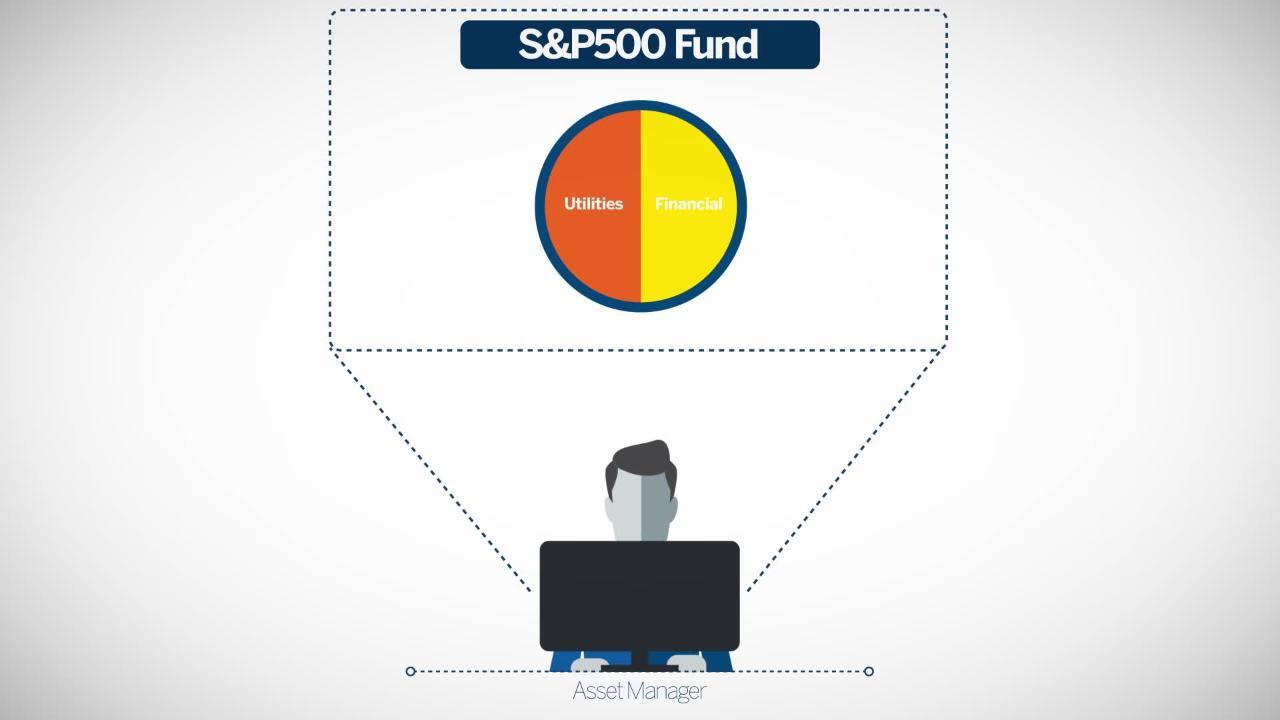
Let’s say that a asset manager has a $100,000,000 fund indexed to the S&P 500. Looking forward, he decides to rotate the portfolio, increasing exposure to utilities and also decreasing exposure to financials by 10%.
The portfolio manager elects to adjust his $100 million portfolio using Select Sector futures. He will buy Utilities Select Sector Futures and sell Financial Select Sector futures, as shown below.
$100,000,000 x 10% = $10,000,0000
Hedge Ratio (HR) = Value at risk ÷ Notional Value (NV) Sector futures
HRUtilities = 10,000,000 ÷ (700.00 x 100) = Buy 142 XAU contracts
HRFinancials = 10,000,000 ÷ (400 x 250) = Sell 100 XAF contracts
In buying 142 contracts of utilities and selling 100 contracts of financials, he has effectively rotated his portfolio away from financials and toward utilities without changing the physical portfolio.
Summary
Sector rotation is a commonly employed financial strategy. It allows traders to lessen risk by increasing exposure to one sector while minimizing exposure to other sectors. Equity Index Sector futures at CME Group offer the ability to access the individual sectors around-the-clock via CME Globex. In addition to providing capital efficiency, flexible execution methods are available.