Understanding Commodity Storage
Understanding Commodity Storage
Storage facilities play a crucial role in the commodities supply, transportation and consumption chain.
Storage is a means of collecting products before distribution into downstream operations in the midstream sector. Storage is also used by downstream operators as an additional source of supply in the case of supply disruption.
Crude Oil Storage
Crude oil is generally stored in tanks with varying designs depending on the usage. Storage tanks come in all sizes and shapes. Each tank is designed to handle pressure conditions of the liquids, prevent leakage and corrosion and manage ventilation and fumes.
The most common tank is the vertical, cylindrical storage tank. It ranges in size from 10 to 400 feet in diameter. The storage capacity of these tanks also varies widely, from a few hundred barrels to 1.5 million barrels.
Supertankers, like very large crude carriers (VLCC) and Ultra Large Crude Carriers (ULCC), are occasionally used as storage facilities for crude oil and refined products. They are usually above 250,000 deadweight tonnage in size and can carry and store more than 2 million barrels.
Storing oil on a ship is more expensive, and typically used when supply of an energy commodity is significantly greater than demand. U.S. Crude oil storage levels fluctuate with supply and demand. From 2015 to 2024, they have ranged from about 400 million barrels to 530 million barrels.
As crude oil production has grown, significant investments have been made in additional storage capacity. The EIA recently reported working crude oil storage capacity of 680 million barrels, up 30% from 2014.
The storage utilization rate is an important metric to traders because it helps normalize storage levels with capacity. High levels of crude oil storage utilization can be associated with low prices and contango in the WTI futures curve, while lower levels are often associated with higher prices and backwardation.
Natural Gas Storage
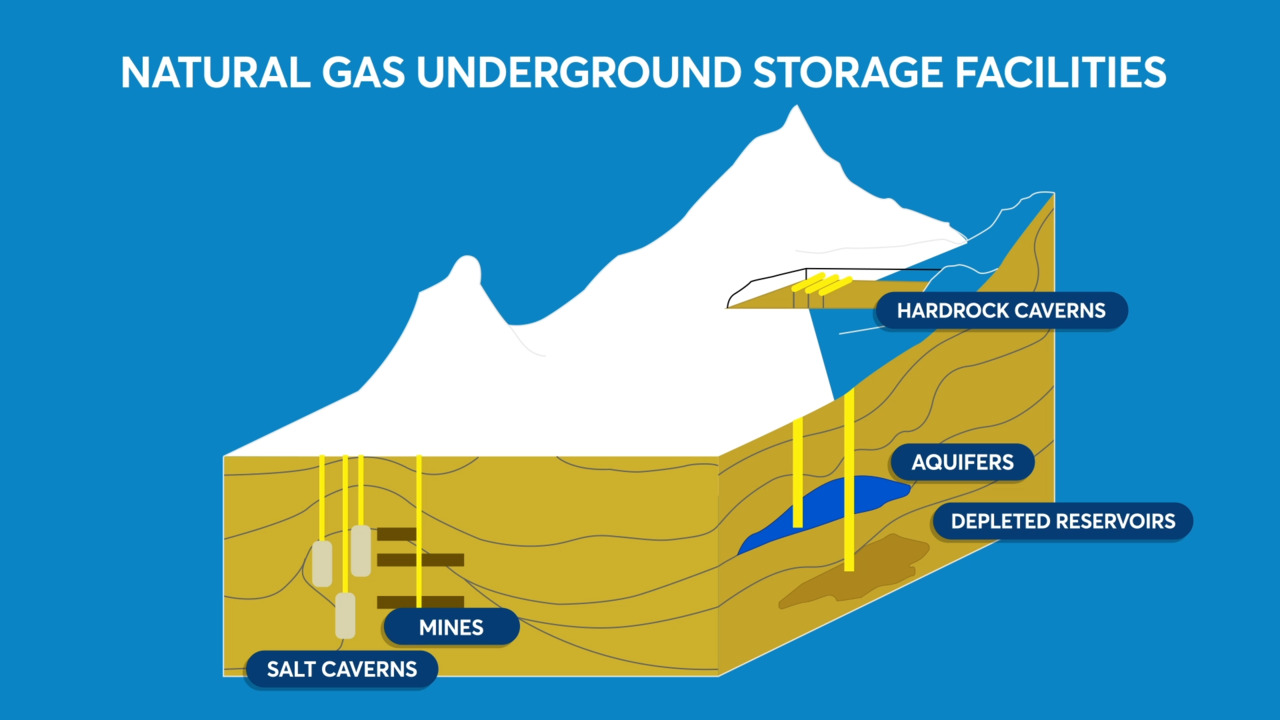
Natural gas typically uses underground storage facilities including salt caverns, mines, aquifers, depleted reservoirs and hard-rock caverns. Natural gas storage plays an important role in meeting the seasonal demand.
Most natural gas is stored in depleted reservoirs. The reservoir’s infrastructure, like a well, gathering system and pipeline connections can be reused. This is more cost-efficient than an aquifer, which consists of water-bearing sedimentary rock.
The volume of natural gas used as the permanent inventory in storage is referred to as Base gas. Working gas refers to the excess volume that can be made available to consumers for use, such as power burn and serving industrial and retail customers.
Working gas follows a seasonal pattern, building inventory in the summer months and drawing in winter to meet peak heating demand. The price of Henry Hub natural gas futures reflects this seasonality: higher prices in the winter provide an incentive for gas to be stored during the summer months.
Electricity Storage
Not all commodities can be economically stored. For example, it is still prohibitively expensive to store electricity in an industrial-level battery plant. Thus, the volatility of electricity prices is generally higher than other commodities, since it is prone to supply and demand disruption risk.
Major price swings, as much as 600% in one day, can occur in electricity. This occurred on May 19, 2017, due to an unexpected heat wave.
Conclusion
Commodity storage plays an important role in balancing supply and demand. When unexpected events disrupt supply, a sufficient storage level will reduce the financial and physical impacts felt by downstream operators while allowing them to continue their operations.
Operators also maintain the option to store commodities physically in a low-price environment and wait for the price to rebound to generate greater profits.
The Energy Information Administration, or EIA, reports U.S. inventories of crude oil, natural gas, and other energy products on a weekly basis. Traders pay close attention to weekly EIA reports, which can impact prices of energy commodities. Inventories that are higher than seasonally normal, are building at a higher than usual rate or drawing at a lower than-usual rate, can be interpreted as bearish. Inventories that are lower than average or that are drawing at a faster than-normal rate, can be interpreted as bullish.
Crude Oil and other petroleum product inventories are reported on most Wednesdays at 9:30 a.m. Central Time. Weekly Working Natural Gas inventories are reported on most Thursdays at 9:30 a.m. Central Time.